How Do I Know If It's a Heel Spur? Signs and When to Get Checked
A practical walk-through of what heel spur symptoms actually feel like, what else causes the same pain, and how to tell when a self-check is enough and when it's time for an evaluation.
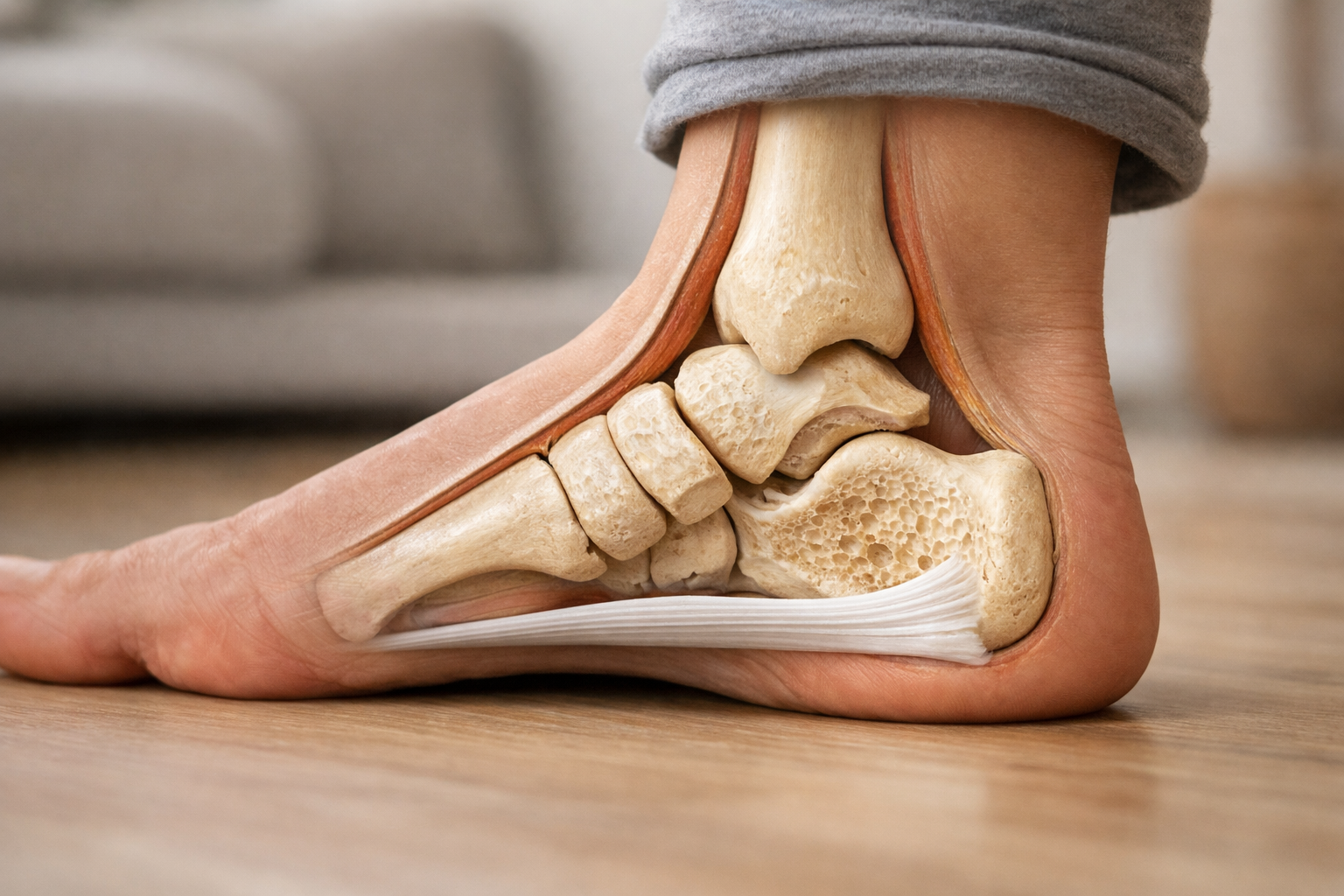
Most people arrive at this question the same way. The heel has been hurting for a few weeks. Someone mentioned heel spurs. Maybe a relative had one. So now you’re pressing on the bottom of your foot, trying to feel a bump, wondering whether there’s a piece of bone in there causing all this.
Here’s the honest answer up front: you can’t tell from the outside, and knowing usually matters less than you’d expect.
That sounds like a dodge. It isn’t. The reason it’s hard to identify a heel spur by feel is that spurs sit deep inside the heel bone, under a thick pad of fat and skin, and they’re small. Some are a couple of millimeters. You are not going to palpate that through your heel pad. And the bigger issue is that people with no heel pain at all routinely turn up with spurs on X-ray, while plenty of people with severe heel pain have no spur whatsoever. So the presence of a spur doesn’t reliably explain your symptoms, and the absence of one doesn’t rule anything out.
What you can do is get much clearer about what your pain is actually doing. That’s the useful information. Let’s go through how to read it.
Why You Can’t Self-Diagnose a Heel Spur (and What You Can Learn Instead)
A heel spur is a small bony outgrowth where soft tissue attaches to the heel bone, usually where the plantar fascia anchors underneath, sometimes where the Achilles attaches at the back. It forms slowly, over months or years, as bone responds to repeated pull and stress at that attachment point. It’s a consequence of load history, not an invader.
Which means the spur is essentially a record of what your foot has been doing, not the cause of today’s pain.
The only way to confirm one is imaging. An X-ray shows it plainly. But imaging answers the wrong question if your real question is “why does my heel hurt and what do I do about it.” I’ve seen X-rays with a prominent spur where the pain was coming from something else entirely, and X-rays with nothing remarkable where the person could barely walk to the mailbox.
So instead of hunting for a bump, start paying attention to the pattern. Pain has a behavior. Where it sits, when it shows up, what makes it worse, how long it takes to settle. That pattern tells us far more than a picture does.
The Pattern That Points Toward Plantar Fascia Trouble
When heel pain comes from the plantar fascia and its attachment (the same area where a plantar heel spur would sit), the story is fairly consistent. This can be consistent with plantar fasciopathy, the term we use for the persistent tissue state rather than the acute inflammation people picture with “fasciitis.”
What you’d typically notice:
- Pain concentrated on the inside-front of the heel pad. Not the whole heel. If you probe around, there’s usually one spot that’s noticeably more tender than the tissue an inch away in any direction.
- The first steps in the morning are the worst part of the day. Sharp, sometimes stabbing. Then it eases over five or ten minutes of walking.
- The same thing happens after sitting. Get up from your desk, from the car, from dinner, and the first few steps hurt again. Less dramatically than the morning, but the same flavor.
- It loosens with movement and then returns later. Often worse at the end of a long day on your feet than at the start.
- Standing still is sometimes worse than walking. A lot of people can walk a mile more comfortably than they can stand in a checkout line for ten minutes.
That morning pattern confuses people the most. It feels like the foot got worse overnight. It didn’t. Hours of no load make the tissue less accustomed to being loaded, so the first demand of the day lands on a system that hasn’t been asked to do anything for eight hours. It’s a sensitivity pattern, not overnight damage.
What the pattern looks like when it’s probably something else
Some details push me away from the fascia:
- Pain at the back of the heel, not underneath. That’s Achilles territory, or the bursa that sits between the tendon and the bone.
- Burning, tingling, electrical, or radiating pain. Especially if it travels into the arch or toes, or if you notice numbness. Nerve involvement changes the approach.
- Pain that’s worse with each step and never warms up. Fascia pain tends to ease with a few minutes of movement. Pain that steadily escalates the more you walk, with no warm-up window, is a different animal.
- Pain that squeezing the heel from both sides reproduces. If gently compressing the sides of your heel bone hurts, that’s worth getting looked at. A stress reaction in the bone behaves differently from soft tissue and is managed differently.
- Swelling, warmth, redness, or pain in multiple joints. Inflammatory conditions can present at tendon attachments, including the heel, and they need medical workup rather than a loading program.
- Pain that came on immediately after a specific moment, like a pop, a misstep off a curb, or landing from a jump. Sudden onset with a clear mechanism is a different conversation from gradual buildup.
None of these are meant to alarm you. They’re just branches in the decision tree, and they’re the reason an in-person exam is worth it when things aren’t clearing up.
What Can Be Mistaken for a Heel Spur?
Quite a lot, honestly. “Heel spur” has become a catch-all label for bottom-of-the-heel pain, the way people say “sciatica” for any leg pain.
Things that produce similar symptoms:
Plantar fasciopathy. The most common by far. And notably, when a spur and fascia pain coexist, treating the fascia is what helps. The spur stays put.
Fat pad irritation or thinning. Your heel has a built-in shock absorber. It can get bruised from a hard heel strike on concrete, and it thins gradually with age. This pain tends to sit in the center of the heel and feels more like a deep bruise than a sharp stab. It’s often worse barefoot on hard floors and better with cushioning.
Nerve irritation. Branches of the tibial nerve pass through the inner ankle and heel. When one gets irritated, the pain can mimic fascia pain closely but usually carries a burning or zinging quality, and it may bother you at rest or at night.
Calcaneal stress reaction. Bone under repeated overload responds. This shows up more in runners, in people who ramped up walking volume quickly, and sometimes in those with lower bone density. It tends to hurt with impact in a way that doesn’t warm up.
Achilles or retrocalcaneal problems. Back of the heel. Sometimes there’s a posterior spur involved, sometimes a thickened tendon, sometimes an irritated bursa.
Inflammatory arthritis. A small subset of heel pain is driven by systemic inflammation at tendon and ligament attachments. Morning stiffness lasting an hour or more, heel pain in both feet, low back stiffness, or joint symptoms elsewhere raise the question.
The practical takeaway: pain in the bottom of the heel narrows the list but doesn’t finish the job. An exam that includes where it hurts on palpation, how your ankle and big toe move, how your calf tolerates load, and what your recent activity looked like sorts this out more reliably than an X-ray does.
How Do You Get Rid of a Spur in Your Heel?
You mostly don’t, and that’s fine.
Bone spurs don’t dissolve with stretching, creams, supplements, or apple cider vinegar. There’s no home remedy that reabsorbs bone. Surgical removal exists but is uncommon and reserved for specific situations after conservative care has genuinely been exhausted. For the large majority of people, the spur stays and the pain still goes away.
Which is the key insight here. The goal was never to remove the spur. The goal is to get your foot back to handling walking, standing, working, and whatever else you want to do without protesting. Those are different targets, and only one of them is worth chasing.
Will a heel spur eventually go away? The bone itself, no, generally not. It’s a structural adaptation, and it tends to persist. The pain associated with it, for many people, does improve substantially. I want to be careful here because that distinction gets blurred constantly and it leaves people feeling doomed. You can be completely comfortable with a spur sitting in your heel. Many people already are and have no idea.
The Actual Mechanism, and Why It Changes What You Do
Here’s the frame I use for nearly every foot problem that builds up gradually.
Your tissues have a certain capacity, meaning how much they can tolerate before they get irritated. Your life places a certain demand on them. When demand outpaces capacity, over days or weeks or a season, you get symptoms. Sometimes that’s because demand jumped (new job standing on concrete, training for a race, a vacation with 20,000 steps a day, new shoes, moving houses). Sometimes it’s because capacity quietly dropped (a few sedentary months, an injury elsewhere that changed how you walk, time in very supportive footwear that let the foot do less).
That frame changes what you do next, because it means calming things down is only half the job.
Rest reduces sensitivity. It genuinely helps when the foot is furious. But rest doesn’t build capacity. This is exactly why so many people describe the same loop: took two weeks off, felt great, went back to normal, pain returned within days. Nothing was wrong with the rest. It just wasn’t followed by a plan to rebuild what the foot could handle. That gap is where most heel pain gets stuck, and it’s usually not anyone’s fault. Advice arrives in pieces (stretch this, wear these, ice that) without anyone connecting it to a progression.
Calming and building are both necessary. Rest equals rust if you stop at the calming part.
Structural change in fascia and tendon comes from gradual mechanical loading over weeks to months. The early improvements you feel in the first couple weeks are largely your nervous system getting more comfortable. The tissue change comes later. For many people that adaptation window runs something like eight to twelve weeks, and that’s a general pattern, not a schedule. Stopping the moment pain resolves, which is often well before the tissue has actually adapted, is one of the most common reasons heel pain comes back.
How to Walk With a Heel Spur
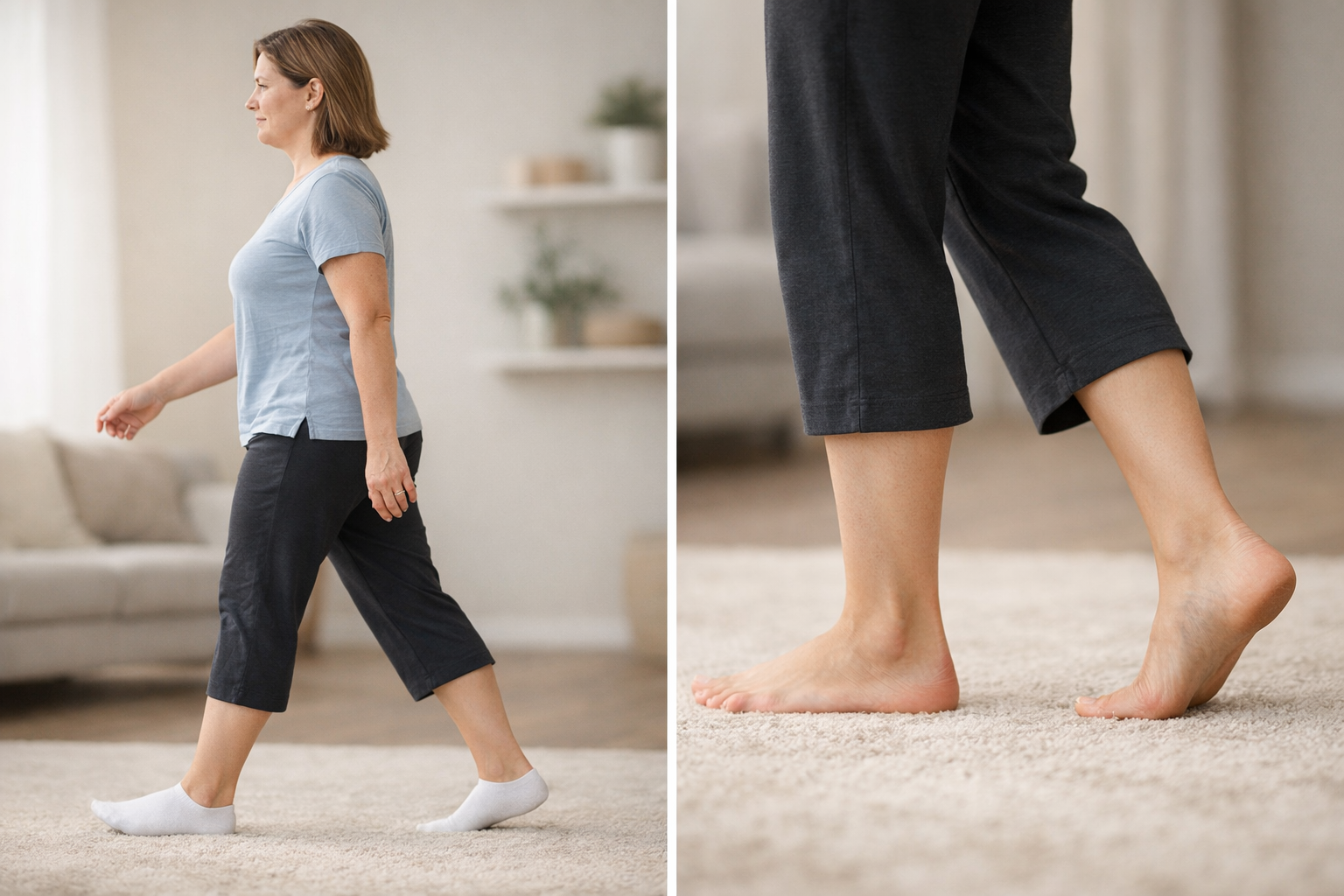
Walk. That’s the short version. But walk thoughtfully.
The instinct when your heel hurts is to limp, land on the outside of your foot, or avoid pushing off. Understandable, and it backfires. Altered walking patterns shift load somewhere else, which is how people with heel pain end up with a cranky knee or hip six weeks later, and the foot gets no practice at doing its job.
Practical adjustments that tend to help:
- Break up the volume rather than cutting it entirely. Three fifteen-minute walks are usually better tolerated than one forty-five-minute walk, even though the total is similar.
- Watch the surfaces. Concrete and tile are demanding. Grass, track, and treadmill are gentler. If your job keeps you on hard floors, an anti-fatigue mat at your station does real work.
- Don’t go barefoot on hard floors first thing in the morning. Keep something supportive by the bed. This is one of the simplest changes with the most noticeable payoff.
- Shorten your stride slightly if you’re limping. A smaller, more even step is usually more comfortable than a long protective one.
- Give yourself a warm-up. Before your first real walk of the day, spend a minute or two moving the ankle and foot, easy calf raises, gentle rolling of the foot. The tissue responds better to a ramp than to a cold start.
As for how much walking is appropriate, use your foot’s response as the guide. A useful working rule for many people: symptoms staying at or below roughly a 4 out of 10 during activity, and settling back to your usual baseline within about 24 hours. If you walked a mile Tuesday and Wednesday morning felt like it always does, that mile was within reach. If Wednesday and Thursday were noticeably worse, that’s information too. Scale back slightly and build from there.
And remember that symptoms often lag a day or two behind the load that caused them. The Saturday flare might be from Thursday’s activity, not Saturday’s.
Is It Good to Rub a Heel Spur?
Rubbing won’t reshape bone, and aggressive digging into an already irritated attachment point can leave you sorer for a day or two without moving anything forward.
Gentle self-massage of the arch and calf, though, is often pleasant and useful. Rolling the bottom of your foot over a ball, working the calf with your hands or a roller, kneading the arch with your thumbs. It tends to reduce sensitivity temporarily, which can make it easier to walk and easier to do your loading work. Think of it as a door-opener, not the treatment.
The distinction I’d make: if it feels like relief, keep going. If you’re gritting your teeth and bearing down on the tender spot because more must be better, stop. There’s no reward for that.
Is Epsom Salt Good for a Heel Spur? And Other Home Remedies
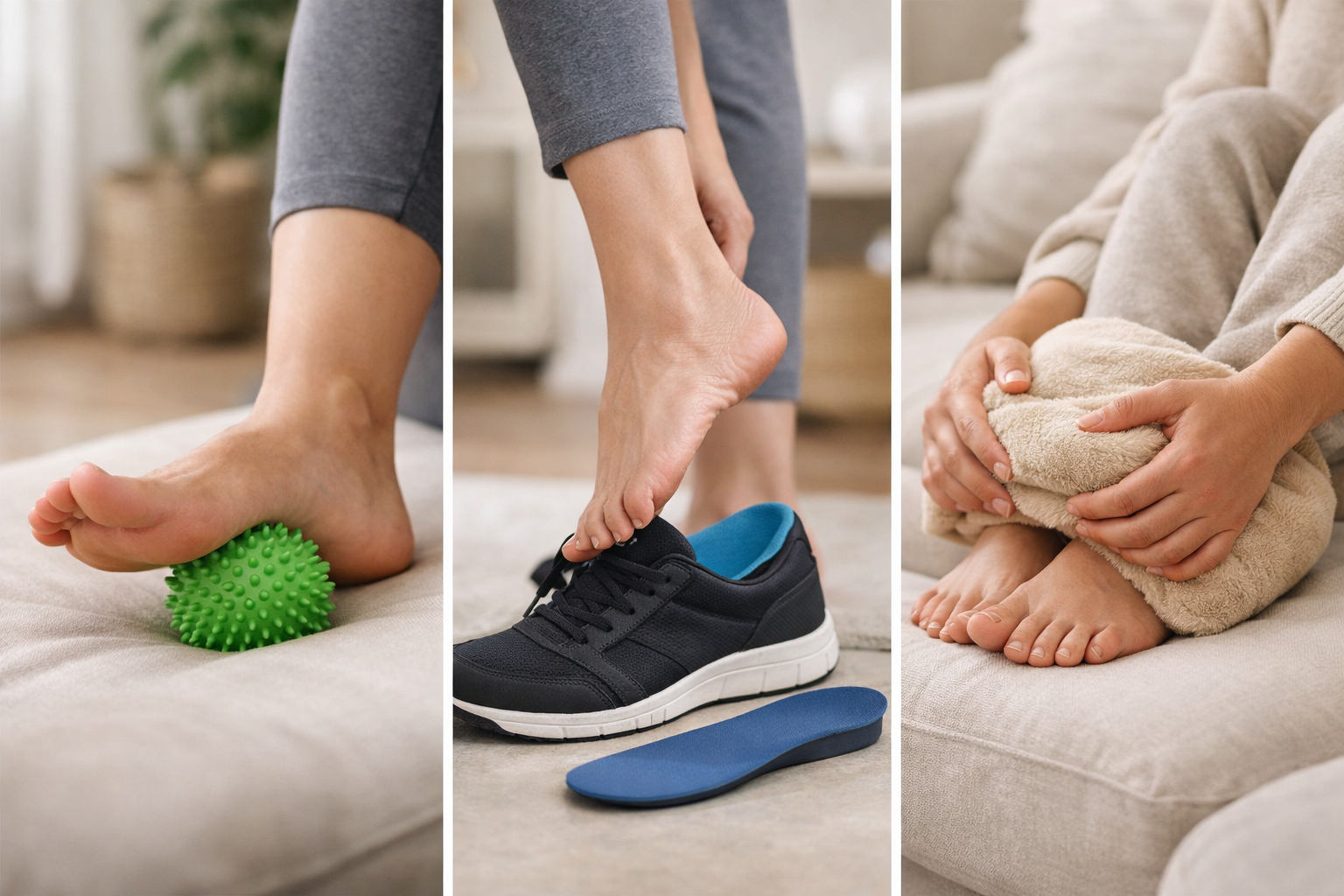
An Epsom salt soak in warm water feels good. Warmth relaxes tissue, the foot gets a break, and you sit down for fifteen minutes, which by itself helps. What it doesn’t do is affect bone, and magnesium doesn’t meaningfully absorb through skin in a way that changes tissue. So enjoy it as comfort care and don’t expect it to be the intervention.
Same reasoning applies across the home-remedy list people ask about:
- Ice. Helpful for calming an angry heel, especially after a heavy day. Ten to fifteen minutes. Doesn’t build anything.
- Heel cups and cushioned insoles. Genuinely useful for reducing the peak stress on a sensitive heel while you’re rebuilding. Many people find them worth using for a stretch and then need them less.
- Night splints. Some people find their mornings much better. Some find them unbearable to sleep in. Worth a try if mornings are your worst problem.
- Over-the-counter anti-inflammatories. Can take the edge off. Worth a conversation with your physician about whether they’re appropriate for you.
- Taping. Can reduce symptoms noticeably for a day or two, which makes it a decent way to test whether offloading the fascia helps you.
- Calf and fascia stretching. Useful, particularly if your ankle doesn’t bend much. Also worth knowing: stretching reduces sensitivity while the tissue is unloaded, which is part of why relief from stretching alone often evaporates once you’re back on your feet. Keep it, but don’t let it be the whole plan.
Notice what these have in common. They all manage symptoms. None of them build capacity. Every one of them is more valuable when it’s buying you room to do the loading work rather than standing in for it.
How to Get Instant Relief From Heel Pain
The fastest things, realistically:
Get off your feet for a bit. Ice the tender spot. Put on your most cushioned shoes and stop walking on hard floors barefoot. Tape the arch or slip in a heel cup. Massage the calf and the bottom of the foot. Elevate.
Those will often take a sharp heel from a 7 down to a 3 within an hour or two. Real relief, and there’s nothing wrong with wanting it.
Just know what you bought. You lowered the sensitivity of the system. You did not change what your foot can tolerate tomorrow. If instant relief is the only tool you ever use, you’ll be reaching for it indefinitely. Heel spur pain relief in the short term and heel pain that stops coming back are two different projects, and you can work on both at once.
What’s the Worst Thing You Can Do for Plantar Fasciitis?
A few candidates, and they’re probably not what you’d guess.
Waiting for the pain to be gone before you start loading the foot. This is the big one. People sit and wait, week after week, expecting the heel to quiet down on its own and then they’ll get back to activity. Meanwhile capacity drifts down, and the eventual return to normal walking lands on a foot that can handle less than it could when this started. You don’t have to be pain-free to begin. You need to find a level of load your foot tolerates and build from there.
Complete rest as a strategy. Rest in small doses calms things. Rest in large doses makes the tissue less capable, and the problem harder. There’s almost always something tolerable you can do.
Pushing straight through sharp pain because you were told to tough it out. The opposite error. Repeatedly loading a heel into an 8 out of 10 and hoping it toughens up mostly keeps it irritated. Load it, yes. Intelligently.
Constantly changing the plan. Two weeks of stretching, then two weeks of a new insole, then a different exercise someone posted online, then a supplement. Nothing gets a fair trial. Tissue adapts to consistent, repeated demand over weeks. Consistency beats intensity here, and jumping between approaches is the single most common reason people conclude that nothing works.
Deciding the spur on your X-ray is a life sentence. A scan can show structural changes, but it doesn’t always tell us why you hurt, and it certainly doesn’t decide how this goes for you. I’ve watched people improve substantially with spurs that hadn’t changed at all.
When to Get It Looked At
A reasonable amount of self-management is fine. Sensible footwear, calming the irritation, gradually rebuilding your walking and standing tolerance. Many people get better doing exactly that.
Worth booking an evaluation if:
- It’s been more than three or four weeks with no meaningful improvement in either pain or what you can do.
- The pain is getting worse rather than better, or it’s spreading.
- You have burning, numbness, tingling, or pain that radiates into the arch or toes.
- Squeezing the sides of your heel bone reproduces the pain, or it hurts with every step without any warm-up period.
- Both heels hurt, especially alongside morning stiffness that lasts a long time or joint symptoms elsewhere.
- There’s visible swelling, redness, or warmth, or you had a fever.
- It started suddenly after a specific injury.
- You have diabetes, neuropathy, circulation issues, or known bone density concerns. The threshold for getting foot pain assessed should be lower in these cases.
An exam sorts out which tissue is actually involved and, more usefully, figures out where your foot currently is and how to progress it. Imaging gets ordered when it would change the plan. Often it wouldn’t.
The question you came in with, how to know if it’s a heel spur, turns out to be less useful than it looks. The better question is what your heel can handle right now, and what the next step up from there looks like. That one you can actually answer, and acting on it is what moves things.
This article is general education, not personal medical advice. Heel pain that’s persistent, severe, or getting worse deserves an in-person evaluation so the right thing can be identified and addressed.