Exercises for Achilles Tendinitis: A Progressive Strength Guide
A stage-by-stage look at how to load a painful Achilles tendon, from calming isometrics to heavy calf raises to running again, plus what to avoid, why stretching often disappoints, and how to read your tendon's response.

Most people come in with some version of the same question: am I supposed to be resting this thing, or working it?
Usually they’ve done both, in an unhelpful order. A few weeks off, which felt better. Then back to running or back on their feet at work, and the pain returned within days. So they rest again. The tendon gets quiet, then loud, then quiet, and nothing actually changes.
Here’s the part that tends to reframe things. Rest lowers how sensitive the tendon is. It doesn’t make the tendon any stronger or any more capable of handling what you’re about to ask of it. That’s why pain comes back the moment load comes back. The tendon didn’t heal during the break. It just stopped being provoked.
So the exercises below aren’t really about pain relief, though many people do feel better fairly early. They’re about building a tendon that can tolerate your life: the stairs, the standing, the hill on your run, the walk through the airport.
Two things that change which exercises are right for you
Before any exercise list is useful, two questions matter.
Where exactly does it hurt? Pinch the tendon between your fingers and work down from the calf. If the tender spot sits in the cord itself, roughly two to three inches above the heel bone, that’s the midportion. If the tenderness is right at the back of the heel bone where the tendon attaches, that’s insertional.
The distinction is practical, not academic. An insertional problem often dislikes positions where the ankle bends far up and the tendon gets compressed against the bone. Which means the classic “drop your heel off a step” exercise, the one on every handout, is frequently the wrong first choice for that group. Same exercise, different pain location, very different response.
How easily does it get irritated right now? A tendon that hurts for the first ten minutes of a walk and then settles is in a different place than one that aches all evening after you’ve been on your feet. The first can usually start with more. The second needs a lower entry point and more patience.
Morning stiffness is a useful gauge here. Most people with a cranky Achilles are stiff and sore for the first steps out of bed. Track roughly how long it takes to loosen up. As that window shrinks over weeks, it usually means the tendon is settling, even if your worst-pain number hasn’t moved much yet.
The rules that matter more than the exercise list
You can pick perfectly reasonable exercises and still get nowhere if the dosing is off. These guidelines are general patterns, not precise prescriptions, and an in-person evaluation will sharpen them for you.
- Keep discomfort at or below roughly 4 out of 10 during the exercise. Some pulling, aching or awareness in the tendon while loading it is normal and generally acceptable. Sharp, climbing pain is a signal to reduce the load, not push through.
- Judge by the next 24 hours. How the tendon feels the following morning tells you more than how it felt during the set. If you’re back to your usual baseline within about a day, the load was reasonable. If you’re worse for two or three days, it was too much, and the next session gets smaller.
- Go slow, and go heavy over time. Tendons respond to sustained tension more than to speed. A three-second lift and a three-second lower beats fast reps almost every time. Progress by adding weight, not by adding endless repetitions.
- Count everything. Total load is cumulative. Your exercises plus your 12,000 steps plus six hours standing at work all land on the same tendon. A flare often comes from the day, not the workout. And symptoms can lag a day or two behind whatever caused them, which is why people so often blame the wrong thing.
- Expect the timeline to be in weeks and months. Early improvements come quickly, and they’re largely your nervous system getting more comfortable and your muscles coordinating better. Real change in the tendon itself typically takes something like 8 to 12 weeks of consistent loading, often longer for a problem you’ve had for a year. This is the single biggest reason tendon pain recurs: people stop when the pain quiets down, which happens well before the tissue has actually adapted.
Consistency beats intensity here. Four honest sessions a week for three months will outperform two heroic weeks followed by a month off.
Stage 1: Calm it down without shutting it down
If the tendon is angry, hurts with most walking, or is sore just sitting there, you’re not starting with heel drops.
Isometric calf holds. Stand with the balls of your feet on the floor, rise up partway onto your toes, and hold. Both feet at first, hands on a counter for balance. Hold for something like 30 to 45 seconds, rest a minute, repeat four or five times. Aim for a load where you feel the calf working hard but the tendon pain stays at 4 out of 10 or under.
Many people find that holding a contraction like this reduces their pain for a few hours afterward. Not everyone. If it doesn’t help, it isn’t a sign something is wrong, and you can move on.
You can do these once or twice a day. As they get easy, shift weight toward the painful leg, then progress to one leg, then hold a dumbbell.
Meanwhile: stay as active as you can tolerate. Walking on flat ground, cycling, swimming, upper body and hip strength work. Complete rest is the one option that reliably fails, because it lowers your capacity while you wait.
Stage 2: The main event, heavy and slow
This is the stage that does most of the work, and it’s the one most often skipped in favor of stretching.
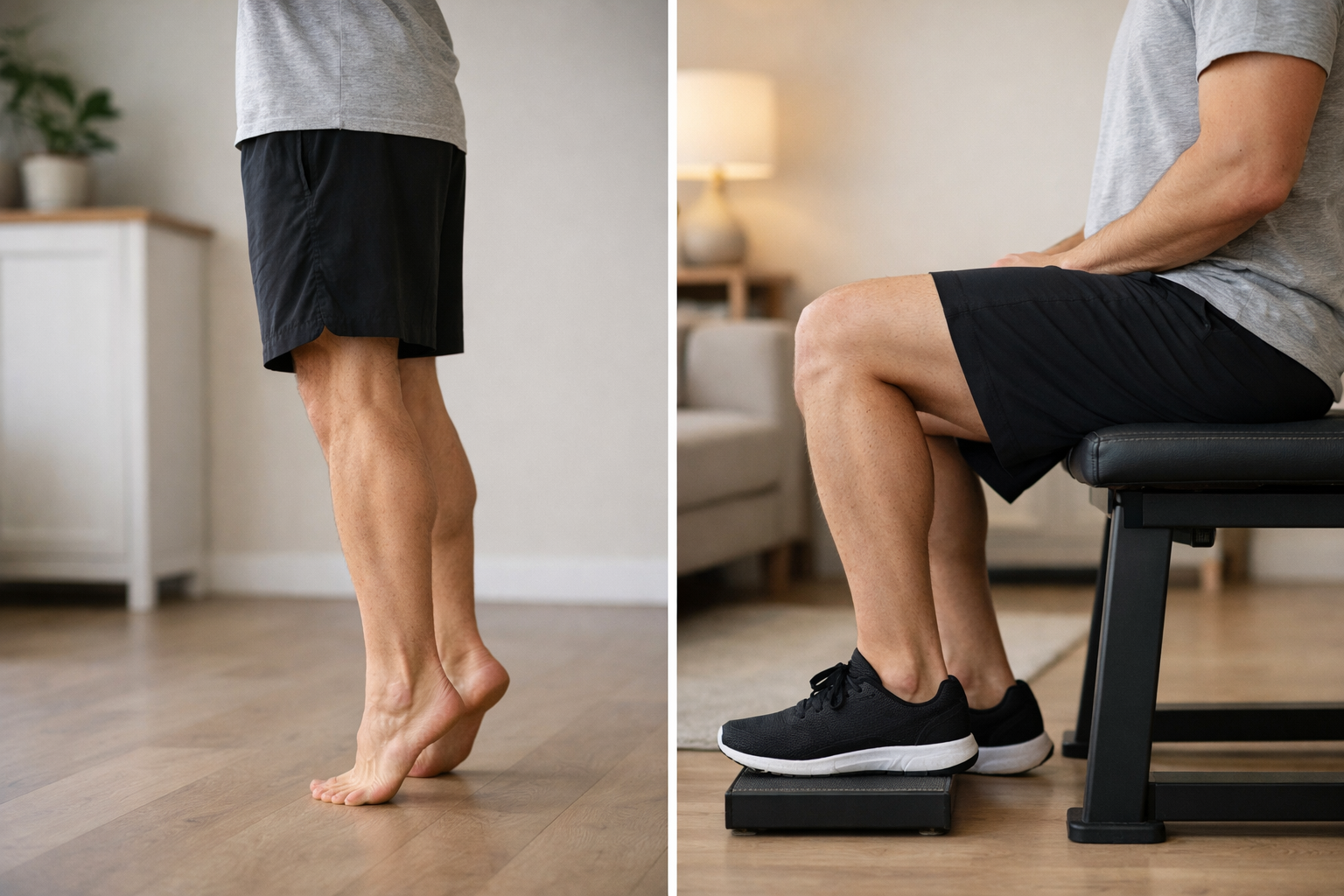
Standing calf raises (straight knee). Feet flat on the floor to start, not on a step. Rise up over three seconds, pause at the top, lower over three seconds. Three to four sets of roughly 6 to 8 reps, every other day. When bodyweight on one leg becomes manageable, add load: a loaded backpack, dumbbells, a calf raise machine. The goal over weeks is that the last two reps feel genuinely hard.
Seated calf raises (bent knee). Sit with your knee bent around 90 degrees, weight on the ball of your foot, and press up through the forefoot with a dumbbell or plate resting on your thigh. Same slow tempo.
Don’t skip this second one. Bending the knee takes the big calf muscle out of the equation and targets the soleus underneath, which carries an enormous share of the load in walking and running. Plenty of people have strong-looking calves, weak soleus endurance, and a tendon that keeps complaining. It’s one of the more common gaps I see in people who have already done months of exercises elsewhere.
About the step. Once you’ve earned it and the tendon is tolerating flat-ground work well, you can add range by letting the heel drop below the level of the step. For midportion pain, that added range is usually valuable. For pain right at the heel bone, hold off, and often stay on flat ground or even put a small heel lift in your shoe for a while. Compression at the attachment point is its own irritant.
Don’t ignore the rest of the leg. Hip and quad strength change how much braking force your calf has to absorb with every step. A tendon problem is rarely a tendon-only problem.
Stage 3: Eccentric heel drops, in context
Eccentric heel drops earned their reputation honestly. The protocol most handouts describe (three sets of 15, twice a day, lowering slowly off a step, using the good leg to get back up) helps a lot of people with midportion Achilles pain.
But two things get lost. First, lowering slowly is just one part of loading a tendon, and research-informed practice has moved toward loading it in both directions with heavier weight rather than treating the lowering phase as magic. Second, that protocol is a large volume of work. Dropped onto an already irritable tendon, it’s a common cause of the “I did my exercises and got much worse” story.
So: useful tool, better placed after you’ve built a base. If heel drops feel productive and your 24-hour response is clean, keep them. If they leave you limping the next morning, that’s information, not failure.
Stage 4: Teach the tendon to be springy again
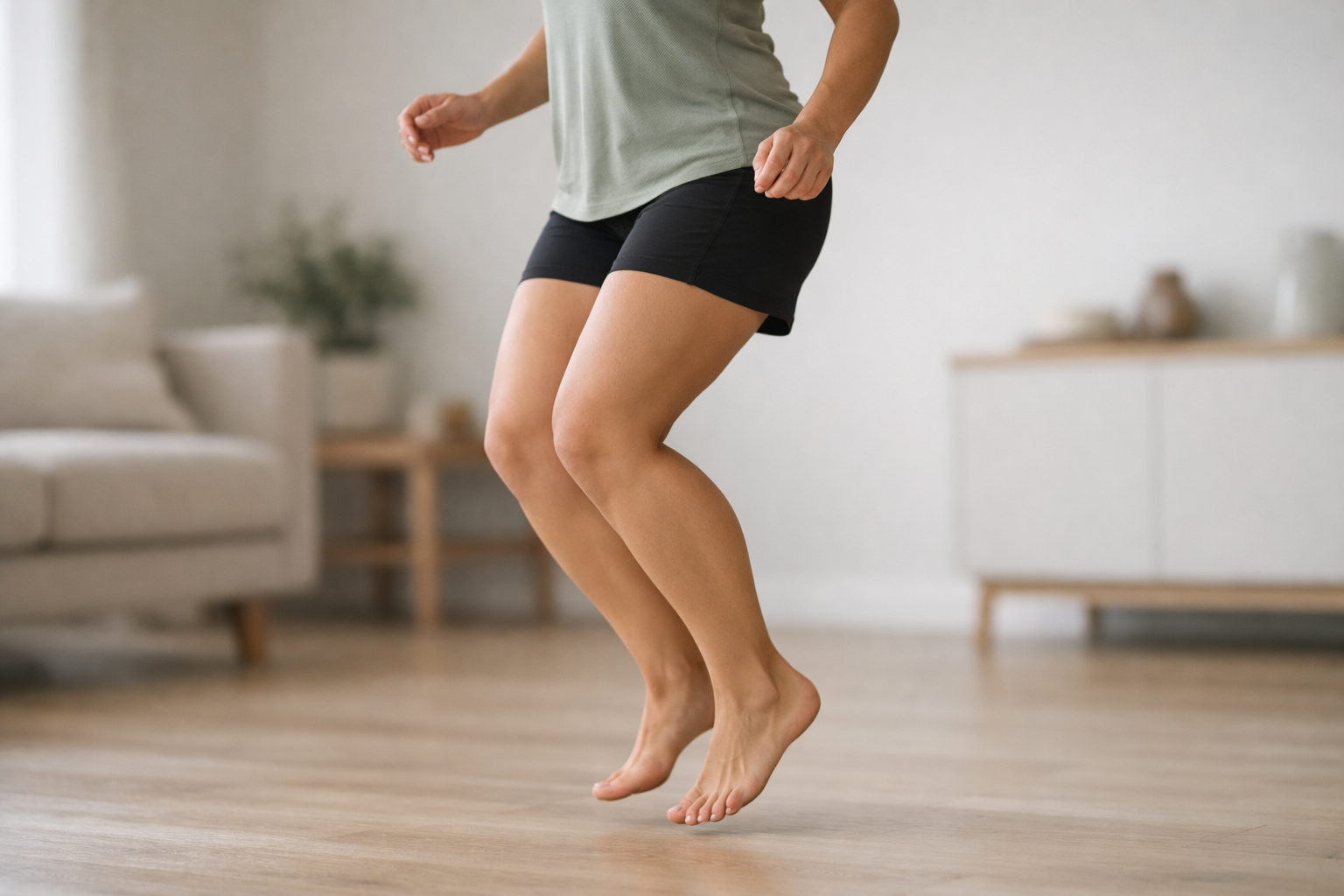
Strength isn’t the finish line if you want to run, play tennis, or chase your kids across a field. Those activities ask the tendon to store and release energy fast. A tendon can be strong in slow calf raises and still get irritated by the first fast thing you do.
When heavy slow work is comfortable and you can do a solid set of single-leg calf raises with decent load:
- Double-leg pogo hops. Small, quick, staying on the balls of your feet. Short sets. Every other day, never on back-to-back days.
- Skipping and rope work. Low and light.
- Single-leg hops, then hops that travel forward and side to side.
- Then running, reintroduced in small doses. Walk-run intervals on flat ground are a reasonable place to start, with hills and speed added last, separately, and not in the same week.
Spring-type work is the most demanding thing you’ll ask of the tendon. Keep it to every other day and keep the 24-hour rule in front of you.
What exercises should you not do with Achilles tendonitis?
Less a banned list, more a timing question. Nearly everything is fine eventually. Early on, these tend to cause trouble:
- Deep, aggressive stretching into a hard end range, especially with insertional pain.
- Hills, stairs and speed work, all of which sharply increase demand on the tendon.
- Plyometrics and jumping before you have a strength base.
- Daily high-volume tendon work with no rest days. Tendons adapt during recovery. Loading them hard every single day usually just keeps them irritated.
- Anything that leaves you clearly worse for multiple days. That’s the real criterion, and it’s individual.
What also worsens it, outside the gym: a sudden jump in walking or running volume, a new pair of shoes with a much lower heel than you’re used to, a vacation spent in flat sandals after a winter in boots, switching from a desk to a standing job. A tendon can handle a lot. It handles change poorly. Added body weight, standing work and long days on hard floors all raise the total demand on the system, which is worth knowing simply because it tells us where the starting point needs to be, not because any of it is a personal failing.
Should I stretch a sore Achilles tendon?
Gentle calf stretching feels good to many people, and there’s no reason to forbid it. Just be clear about what it’s doing. Stretching temporarily reduces how sensitive the area feels. It doesn’t build capacity, and it doesn’t change the tendon’s structure.
If your ankle genuinely doesn’t bend much, improving that range can be worth pursuing. If you’re stretching hard several times a day and wondering why nothing has changed in three months, the stretching isn’t the problem. The missing piece is usually the loading, done heavy and done long enough.
With insertional pain, hard stretching can provoke things, because it drives the tendon into the bone. If a stretch consistently makes the next morning worse, stop doing it.
Should I massage or rub my Achilles?
Rubbing the tendon or the calf is generally safe and often feels good for a while. Same category as stretching: it can turn the volume down on a sensitive area, which is worth something, particularly if it lets you do your strength work more comfortably.
What it won’t do is remodel the tendon. There’s no amount of rubbing that builds tissue capable of handling a 5K. And digging aggressively into an already inflamed, swollen insertion can leave it more irritated. Moderate pressure, sensible expectations, and don’t let the massage become the plan.
What is the best over-the-counter cream for Achilles tendonitis?
Topical anti-inflammatory gels containing diclofenac are available over the counter in many places and can take the edge off, especially in a flared, irritable phase. Menthol-based rubs give temporary relief through a cooling sensation and nothing more. Neither one changes the tendon.
If you use a cream, use it so you can keep moving and keep loading, not so you can ignore symptoms and push through something your tendon isn’t ready for. Anything you take or apply regularly is worth running past your physician or pharmacist, particularly if you’re on other medications.
What is the fastest way to heal Achilles tendonitis?
The honest answer is unsatisfying and genuinely useful: start loading it appropriately, early, and don’t stop too soon.
The fastest routes I see share a few features. Pain is caught before it’s been there a year. Activity is modified rather than abandoned. The strength work is heavy enough to matter and continues for a couple of months past the point where pain stops being the main complaint. Spring-type loading gets added before a return to sport instead of after.
The slowest routes also share features. Long periods of complete rest. A return to full activity the week the pain quiets down. Stretching and rolling as the entire plan. Exercises done for two weeks, judged a failure, then swapped for different exercises, repeatedly.
Recovery is built. There’s no version where you wait it out and the tendon gets stronger on its own.
Is the Achilles the hardest tendon to heal?
It’s a reasonable candidate, and people ask this a lot. Tendons in general have a modest blood supply and adapt more slowly than muscle. The Achilles compounds that by carrying loads several times your body weight with every running stride, and by being nearly impossible to unload in daily life. You can rest a shoulder tendon. You can’t easily rest something you stand on.
The insertional variety is often the more stubborn of the two, because of the compression issue and because the tolerable range of motion is narrower early on.
None of which means slow equals hopeless. Persistent doesn’t mean permanent. A tendon you’ve had trouble with for two years usually means a lower starting point and a more patient climb, not a different destination.
Do you ever fully recover from Achilles tendonitis?
Many people do return to everything they care about, including distance running and competitive sport. Some notice their tendon stays a bit thicker, or that it speaks up if they jump their training volume too quickly. That’s a tendon with a ceiling, not a broken tendon, and the ceiling generally rises with continued loading.
The more useful way to track recovery is capability, not just the pain score. Are you walking farther before it complains? Standing longer at work? Recovering by the next morning instead of over three days? Getting out of bed with less stiffness? People frequently improve on all of those while still having some tendon awareness. Function matters as much as pain.
The part worth taking seriously long-term: keep doing calf work. Not the full rehab program forever, but a couple of heavy sets a week, ongoing. The people who hold onto their gains are almost always the ones who never fully stopped loading.
When it flares
It will, at some point. A soccer game, a long travel day, a week where you got ambitious.
A flare doesn’t erase what you built. Tendons get sensitive quickly and settle fairly quickly too. Drop back to a level you tolerate, often isometrics and reduced walking, for a few days. Then step back in where you left off, or one notch below. Look at what changed in the two days before the flare, because it’s usually identifiable and usually not the exercises themselves.
What you’re watching is the trend across weeks, not the reading on any single day. Recovery isn’t a straight line, and a chart with dips in it can still point clearly upward.
When to have someone look at it
Get evaluated if the pain is severe, keeps worsening despite sensible management, or has been hanging around for months without change. Go promptly if you felt a sudden snap or pop at the back of the ankle, if you can’t push off to walk normally, or if you noticed a distinct gap or divot in the tendon, since that picture needs ruling out quickly.
Also worth checking: swelling with redness and warmth, tendon pain that started soon after a new antibiotic, morning stiffness lasting well over an hour, or pain in multiple tendons at once. Not everything at the back of the heel is tendon pain either. Bursitis, a bone issue, nerve irritation and a few other things can mimic it closely, and sorting that out changes the plan.
If you’ve already put in months of honest effort and stalled, it’s often not that the exercises were wrong. It’s that nobody mapped out how to progress them, or how far the progression actually needs to go before your tendon is ready for what you want to do.