Treating Heel Bone Spurs: From Conservative Care to Advanced
A practical walk through how heel bone spur pain is actually treated, from calming an irritated heel to rebuilding what it can handle, plus where orthotics, injections, shockwave, and surgery fit in.
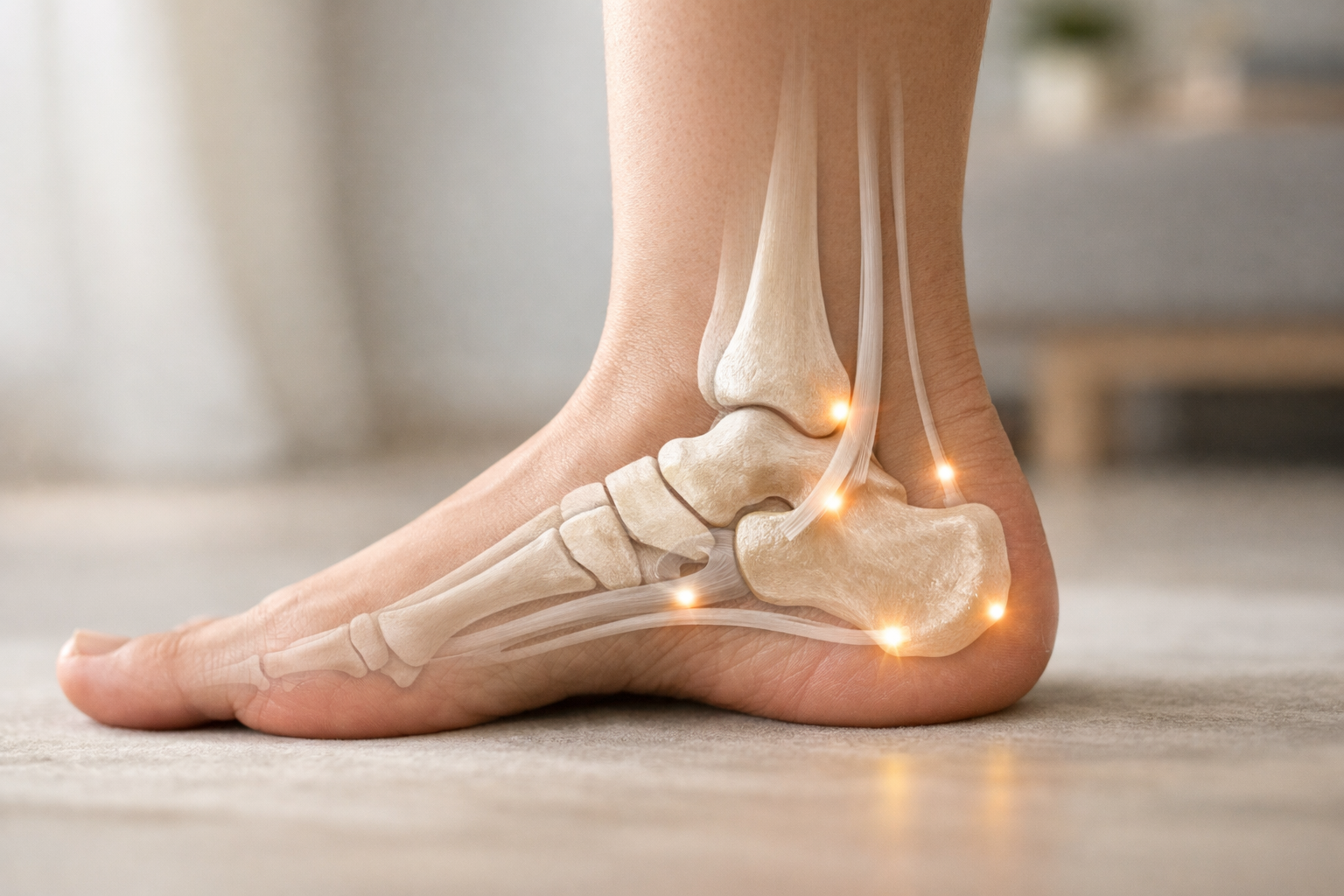
Most people arrive at this question holding an X-ray report. There’s a spur on the heel bone, and it seems to explain everything. The pain, the limping first thing in the morning, the way standing on a hard floor for twenty minutes makes you want to sit down. So the natural question becomes: how do you treat bone spurs in the heel?
Here’s the honest starting point. In most cases, we don’t treat the spur. We treat the heel.
That isn’t a technicality. It changes what your plan should look like, how long it takes, and what counts as progress. The spur is usually a slow bony response to years of tension and stress at that spot. It’s more like a callus on bone than a thorn stuck in your foot. Plenty of people have one and feel nothing. Plenty of people have heel pain with no spur at all. Recovery tends to look about the same either way. (If you want the deeper reasoning behind that, our article on plantar fasciitis versus heel spurs covers it.)
So let’s spend the time where it matters: what actually helps, in what order, and why.
Step one: calm the heel down without shutting it down
When a heel is angry, the first job is to bring the sensitivity down enough that you can start doing productive work. Not to eliminate pain before you do anything. Just to get it out of the red zone.
Things that often help in this phase:
- Trimming the spikes, not the whole day. If standing for ninety minutes straight sets you off, try three thirty-minute blocks with a sit-down in between. Same total, different distribution.
- Ice or a cold pack after aggravating activity, for 10 to 15 minutes. It’s a comfort tool. It buys you a calmer evening; it isn’t changing the tissue.
- A temporary heel cushion or a slightly cushioned, supportive shoe worn indoors. Hard tile and bare feet at home is a bigger contributor than most people realize.
- Taping. A simple low-dye style tape job can take some tension off the arch for a day or two and tell us something useful: if taping helps a lot, load management is likely to help a lot.
- Anti-inflammatory medication, if it’s appropriate for you. It can take the edge off short term. Long stretches of daily NSAID use is a conversation to have with whoever prescribes your medications, not something to drift into on your own.
Notice what’s missing from that list: complete rest. Rest is genuinely useful in small doses and genuinely counterproductive in large ones. Two or three quieter days can settle an irritated heel. Two or three quiet weeks will settle it and also leave you with a heel that tolerates less than it did before. Then the first normal day back hurts, and it feels like the problem never improved.
That’s the trap. Rest and stretching lower how sensitive the tissue is while it isn’t being asked to do much. They don’t change what it can handle. Which is why the pain comes back the moment life comes back.
Is walking good for a heel spur?
Usually yes, at the right dose. Walking isn’t damaging your heel. It’s the thing your heel needs to get good at again.
The question isn’t walk or don’t walk. It’s how much, on what surface, in what shoes, and how does your heel respond.
Two rough guides I use with a lot of people:
- Keep discomfort at or under about a 4 out of 10 during and right after walking. Not zero. Tolerable, and not something you’re bracing against.
- Judge by the next 24 hours. If your heel is roughly back to its usual baseline by the next morning, that walk was a reasonable dose. If you’re noticeably worse the next day, or your morning stiffness lasts much longer than usual, that was more than your heel was ready for. Pull back a notch and try again, not back to zero.
One more thing about walking that trips people up: symptoms often lag. The heel that hurts Wednesday morning may be responding to Monday’s long day at a conference, not to Tuesday’s exercises. When we’re sorting out a flare, we look back a couple of days, not just at what you did that morning.
The part that actually changes things: building capacity
This is where treatment stops being about comfort and starts being about capability.
Your heel hurts because the demand on that tissue has been running ahead of what it can currently tolerate. Long days, new shoes, a new job on your feet, a jump in mileage, a change in how much total standing your week contains. The solution is to raise what that tissue can tolerate, and the only thing that reliably does that is gradually asking it to do more, over weeks.
In practice that usually means:
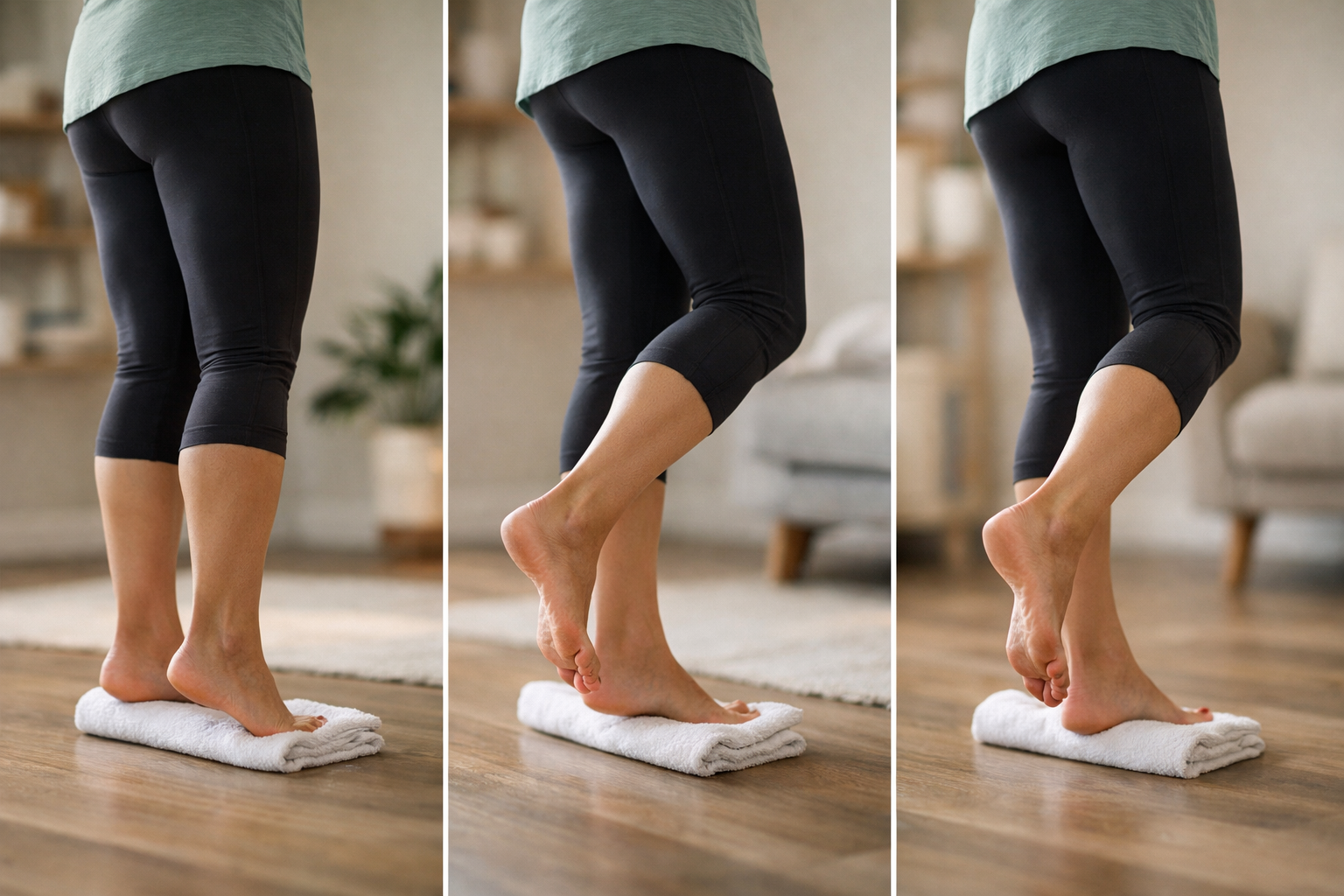
- Calf and Achilles strength work. Heel raises, done slowly, with control, eventually with load. Both legs, then one leg, then one leg with weight. Your calf complex absorbs an enormous amount of force every step. When it’s underpowered, your arch and heel absorb more.
- Foot and toe strength. The small muscles under the arch and the big toe flexors matter more than they get credit for. Toe presses, arch work, exercises where you’re loading through the ball of the foot with the heel lifted.
- Loading the tissue where it actually hurts. For plantar heel pain, that often means heel raises with the toes propped up on a rolled towel, which puts real tension through the plantar fascia under load. It should be challenging. It should not be a 7 out of 10.
- Progressing the thing you want back. If the goal is standing a full shift, standing tolerance gets built on purpose. If the goal is running, walk-run progressions come in once your walking tolerance is solid.
Timing, honestly: the first few weeks of improvement are largely your nervous system getting better at recruiting muscle and being less protective. That’s real, and it feels great. But the tissue itself changes more slowly. For many people, meaningful structural adaptation takes something in the range of 8 to 12 weeks of consistent loading, sometimes longer when the problem has been around for years.
Which brings up the most common reason heel pain returns: stopping when the pain stops. The pain often quiets down well before the tissue has actually adapted. If you stop there, you’ve got a heel that feels fine at your current activity level and no more capacity than it had before. Then life gets busier, and you’re back.
Stay at each level long enough to adapt. Then advance. Consistency beats intensity here, by a wide margin.
What triggers heel spurs and heel spur pain?
The spur itself forms slowly, over years, in response to repeated tension and stress at the attachment on the heel bone. You don’t develop one over a weekend.
The pain, though, usually has a trigger, and it’s almost always a change in load. Common ones:
- A new job, or the same job with more hours on your feet
- A meaningful jump in running or walking volume
- New shoes, or worn-out shoes, or switching from supportive shoes to flat ones
- A vacation with a lot of walking on hard surfaces in sandals
- Coming back to activity after time off
- A change in body weight, which raises the total load the system handles every single step
That last one deserves a plain word. It’s a load factor, not a character flaw. Every step asks your foot to manage your body weight, so weight changes how much demand the tissue sees, the same way adding miles does. It’s one input among several, and it’s not the reason you’re hurting on its own.
The useful question after a flare is never “what did I do wrong.” It’s “what changed.”
Can I get rid of bone spurs naturally? Do heel bone spurs ever go away?
Straight answer: the bone doesn’t dissolve. No stretch, supplement, cream, massage tool, or diet makes a calcification on your heel disappear. If a product promises that, it’s promising something bone doesn’t do.
But that’s a different question from whether the pain goes away, and the pain very often does. People get back to full days on their feet, back to running, back to no morning limp, with the spur still sitting there on the X-ray exactly as it was. That’s the whole point of treating the heel rather than the spur.
So “naturally,” if it means without injections or surgery, yes, a lot can be done and most people start there. Just not by removing the bone.
What happens if heel spurs go untreated?
Some heel pain settles on its own, especially if the load that triggered it goes away. A lot of it doesn’t.
When it drags on, what I typically see isn’t the heel falling apart. It’s the gradual shrinking of life around the pain. You walk less. You stop the evening loop around the neighborhood. You stand differently, favoring the other side, and a few months later the opposite hip or knee starts complaining. Calves get tight and weak at the same time. The heel that tolerated an hour now tolerates twenty minutes.
That’s the real cost of waiting it out: the starting point gets lower, and the road back gets longer. Longstanding heel pain is still very treatable. It just usually means starting gentler and progressing more patiently. Persistent doesn’t mean permanent.
What shoes are best for heel spurs?

There’s no single best shoe, and I’d be suspicious of anyone who names one brand for everybody. What matters is what reduces demand on the painful tissue while you build it back up.
Generally worth looking for:
- Some heel height relative to the forefoot. A modest heel-to-toe drop takes tension off the Achilles and the plantar fascia. Completely flat, zero-drop shoes ask more of that tissue, which is fine later and often too much early.
- A sole that doesn’t fold in half easily. Some stiffness through the midfoot means the shoe shares the work.
- Cushioning you actually find comfortable. Comfort is a reasonable guide here.
- Shoes indoors. If you spend hours barefoot on tile or hardwood, that’s often a bigger load than your workout. A supportive house shoe or sandal can change your week.
If your pain is at the back of the heel rather than underneath, the priorities shift. A rigid heel counter pressing on an irritated Achilles insertion can be the aggravator, and an open-back or soft-back shoe may feel dramatically better.
And whatever you change, change it gradually. A new shoe with a different geometry redistributes load. Even a better shoe can cause a flare if you wear it all day, day one.
Where orthotics, night splints, and other tools fit
These all have a place. They’re just support for a plan, not a plan by themselves.
Orthotics or supportive inserts reduce the demand on irritated tissue, which can make the difference between a tolerable work shift and a miserable one. Over-the-counter versions help plenty of people. Custom devices make more sense when the foot has an unusual shape or structure, or when simpler options have genuinely failed. What orthotics don’t do is build capacity. If they’re the only intervention, you tend to stay dependent on them.
Night splints hold the ankle and toes in a slightly stretched position overnight. Some people find their first steps in the morning noticeably easier. Others can’t sleep in one at all, which makes it a bad trade. Worth trying, not worth suffering for.
Stretching reduces sensitivity and improves how the first few steps feel. It’s a legitimate part of the picture. It just isn’t the part that changes what the tissue tolerates, which is why stretching alone so often produces weeks of temporary relief and no lasting change.
What will a podiatrist do for bone spurs?
A good podiatry visit usually includes a hands-on exam to locate exactly where the pain lives, an X-ray (which is what identifies the spur in the first place), sometimes ultrasound to look at the fascia or tendon, and a discussion of footwear, load, and whether an orthotic makes sense. Many will also offer injections or shockwave, refer you for rehab, and in a small number of cases discuss surgery.
Different clinicians bring different tools, and that’s genuinely useful. A podiatrist can rule out things a rehab-focused exam won’t catch, like a stress fracture or a systemic inflammatory condition. Where care sometimes falls short isn’t in any one provider’s skill. It’s in the handoff. An injection calms things down, an insert makes standing easier, and nobody ever maps out how to get the heel from tolerating twenty minutes to tolerating a full day. That gap is where recurrence lives.
Medical interventions, and when they’re reasonable
Corticosteroid injections. These can be very effective at reducing pain in the short term, and for someone who can barely walk, that relief can be what makes rehab possible. They’re best thought of as a window, not a treatment. Repeated injections into the same area carry real concerns, including thinning of the protective fat pad under the heel and, uncommonly, rupture of the plantar fascia. Worth having, worth not stacking up.
Extracorporeal shockwave therapy. A series of sessions applying acoustic energy to the painful area. It’s a reasonable option for pain that’s persisted for months despite good loading work, and many people report improvement. It works best alongside progressive loading, not instead of it.
Injections of blood-derived products (PRP and similar) are offered in some clinics for longstanding cases. The evidence is still developing. Not unreasonable to discuss; not something to expect miracles from.
Surgery. Rare, and appropriately so. Options may include releasing part of the plantar fascia, removing the spur, or addressing a nerve entrapment, depending on what’s driving the pain. It’s a conversation for someone who has done months of legitimate conservative work without meaningful change. And even after surgery, the heel still has to be rebuilt. The tissue has to relearn how to handle standing, walking, and load. Skipping that part after surgery produces the same problem as skipping it before.
What is the fastest way to heal a heel spur?
The fastest route is the one you don’t have to restart.
What slows people down isn’t a lack of aggressive treatment. It’s the stop-start pattern: push hard for four days, flare, rest for ten, feel better, push hard again. Six weeks pass with no net gain. Meanwhile someone doing a slightly boring amount of loading five or six days a week, all the way through, is quietly getting somewhere.
So the practical version of “fastest”:
- Get an accurate picture of what’s actually causing the pain, because not all heel pain is the same problem.
- Bring the irritation down enough to work, using load management and comfort tools.
- Find the amount of loading your heel can handle right now, and do it consistently.
- Add a little as it adapts, using your response over the following day as the guide.
- Keep going past the point where the pain stops, so the tissue catches up to your life.
That’s it. Recovery is built, and it’s built at the pace your body adapts, not the pace you’d prefer.
What can be mistaken for a heel spur?
Quite a few things, which is why an evaluation matters before you commit to months of treatment for the wrong problem. Heel pain can come from an irritated nerve on the inner heel, a calcaneal stress fracture (particularly if pain came on with a spike in running and hurts when you squeeze the heel from both sides), thinning of the heel’s fat pad, Achilles problems at the insertion, tarsal tunnel irritation, referred pain from the low back, or an inflammatory arthritis that happens to show up first in the heel. Some of those need a very different approach. A few need imaging or bloodwork to sort out.
A spur on the X-ray doesn’t rule any of those out. It only tells you a spur is present.
Flare-ups will happen
At some point in this process you’ll have a day where your heel hurts more than it did last week, and it will feel like everything you’ve built just evaporated. It didn’t.
A flare is information. Usually it means the total load that week was more than the heel was ready for, and remember that total load includes the airport, the wedding, the day of yard work, and the exercises. Look at what changed. Drop back a level for a few days. Then get going again.
What I watch across weeks is the trend, not the day. Are you walking farther before it talks to you? Is the morning stiffness shorter? Are you recovering from a long day faster than you did a month ago? Those can all be improving while the pain number on a bad day is unchanged. Function matters as much as pain.
When to get it looked at
Most heel pain is manageable and doesn’t require urgent attention. Get in with a clinician if your pain has persisted for more than a few weeks without improvement, if it’s severe enough to change how you walk, if it came on suddenly with a pop or sharp tearing sensation, if there’s swelling, redness, warmth, numbness or tingling, if it hurts at rest and at night, or if you have multiple painful joints. Those patterns point away from ordinary heel overload and deserve a proper look.
And if you’ve already done rest, ice, stretching, inserts, and maybe an injection, and you keep landing back in the same place, the missing piece may not be another treatment. It may be a plan for how to progress.