Achilles Tendon Stretches That Actually Help (And When to Skip Them)
A practical guide to stretching a sore or stiff Achilles: which stretches are worth your time, how to tell the difference between tightness you should stretch and tightness you shouldn't, and what to do when stretching makes things worse.
Most people who come in asking about Achilles tendon stretches have already been stretching. Often for weeks. They stretch against the wall before a run, they hang their heels off a stair, they do the towel pull in bed before their feet hit the floor. And the tendon still feels tight, still barks in the morning, still aches after a long day.
So the honest first question isn’t “which stretch?” It’s “is stretching the right tool for what’s actually going on?”
Sometimes yes. Sometimes the tightness you’re feeling isn’t short tissue at all, and pulling harder on it is like turning up the radio to fix an engine noise. Let’s sort out which situation you’re in, because that determines whether these stretches help you or frustrate you.
Two different kinds of “tight”
When people say their Achilles feels tight, they usually mean one of two things, and they feel surprisingly similar from the inside.
Genuine restriction. Your ankle doesn’t physically bend as far as it should. You can test this roughly: stand facing a wall, put your toes a few inches back from it, and try to drive your knee forward to touch the wall while keeping your heel flat. If your heel lifts early, or one side clearly goes further than the other, there’s a real range-of-motion limit. Stiff ankles like this show up after a period in a boot, after an ankle sprain, in people who live in heeled or stiff shoes, and in plenty of runners who’ve never stretched a day in their lives.
Protective tension. The joint moves fine, but the calf and Achilles feel guarded, ropey, stiff first thing in the morning, and heavy after activity. This is an irritated, under-capacity tendon telling you it’s working near its limit. Nothing is short. The tissue is sensitive.
Stretching helps the first one meaningfully. For the second, stretching often feels good for about twenty minutes and then the tightness comes right back, because the tightness was never the problem. It was the symptom.
That’s the part most stretching advice skips. A sensitive tendon feels tight precisely because it’s being asked for more than it can currently give.
First, what are the early signs you’re dealing with an Achilles problem?
People usually notice, in roughly this order:
- Stiffness or soreness in the back of the heel or a few inches above it in the first several steps of the morning, which eases as you move.
- The same stiffness after sitting through a meeting or a long drive.
- Pain that warms up during the first ten minutes of a run or walk, feels better in the middle, and then shows up again that evening or the next morning.
- Tenderness you can pinch between two fingers, in one specific spot, not a vague area.
- A subtle loss of pop. Hills feel harder. You stop doing single-leg heel raises on that side without deciding to.
A pattern like that can be consistent with Achilles tendinopathy (the broader, more accurate term for a tendon that’s been irritated and under-loaded for a while). Early on it’s often dismissed because it warms up. Warming up is not the same as getting better. It’s one of the most recognizable features of tendon pain, and it’s also the reason people run on it for six months before they do anything about it.
How to loosen Achilles tendon tightness
Here’s the sequence that tends to work, in order of how much it actually changes things.
1. Move the ankle before you stretch it
Before holding anything, give the ankle ten to fifteen slow, easy repetitions of bending and pointing, then some gentle ankle circles. Then rock forward and back in a half-kneeling position, letting the knee travel over the toes and back. Movement through range does more for morning stiffness than a static hold, and it’s far less likely to provoke a sore tendon.
This is also the honest answer to the popular question of how to loosen your Achilles in 30 seconds. You can absolutely get a short-term change in 30 seconds. Rock the ankle, do a few slow calf raises, walk around the kitchen. The tendon will feel looser. What you cannot do in 30 seconds is change the tissue, and that’s worth being clear-eyed about so you’re not disappointed when the tightness returns by afternoon.
2. The gastroc stretch (knee straight)
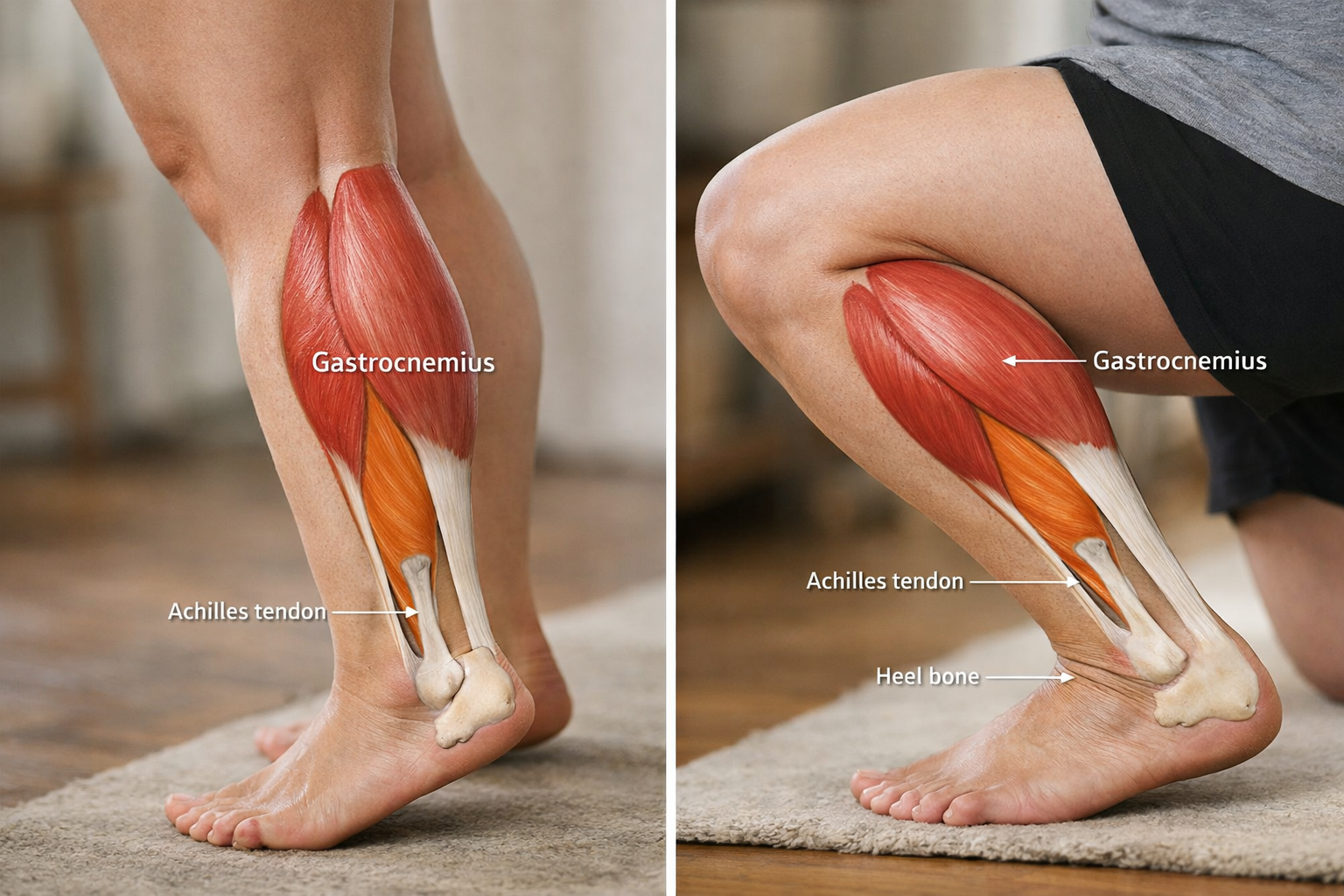
This targets the bigger calf muscle that crosses both the knee and the ankle.
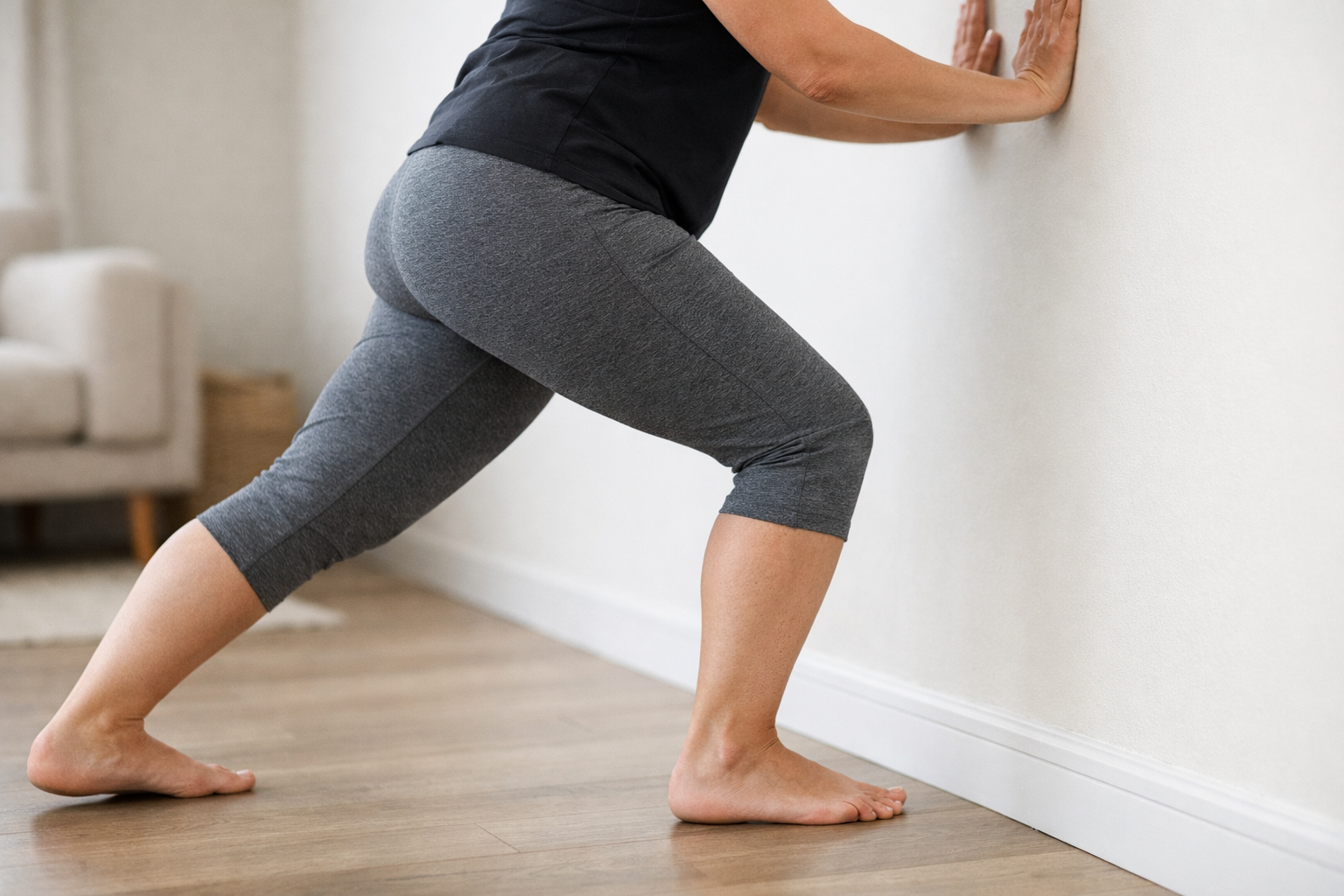
- Face a wall, hands on it at shoulder height.
- Step one foot back about two to three feet, back knee straight, back heel flat on the floor.
- Point both feet straight ahead. Don’t let the back foot roll inward or the arch flatten. If it collapses, shorten the stride.
- Shift your weight gently toward the wall until you feel a clear pull in the upper calf.
- Hold 30 to 45 seconds. Two or three rounds per side.
The common error is going too long with the back foot and letting the arch cave in, which sends the stretch into the foot rather than the calf.
3. The soleus stretch (knee bent)
The soleus sits underneath the gastroc, crosses only the ankle, and feeds directly into the Achilles. If you’re only doing straight-knee stretches, you’re missing the muscle that matters most for walking and for that stiff-first-steps feeling.
- Same wall setup, but bring the back foot in closer.
- Bend the back knee while keeping the heel down.
- You should feel it low, deep, just above the heel rather than up in the belly of the calf.
- Hold 30 to 45 seconds, two or three rounds.
Most people feel considerably more from this one and are surprised by it.
4. The step stretch, with a caveat
Standing with the ball of your foot on a stair and letting the heel drop is the classic. It gives the deepest stretch, which is exactly why it’s the one most likely to aggravate an angry tendon, especially if the pain sits right at the back of the heel bone. Use it if your ankle is genuinely stiff and the tendon tolerates it. Skip it if you’re in a sensitive phase. More on that below.
5. The towel or strap stretch
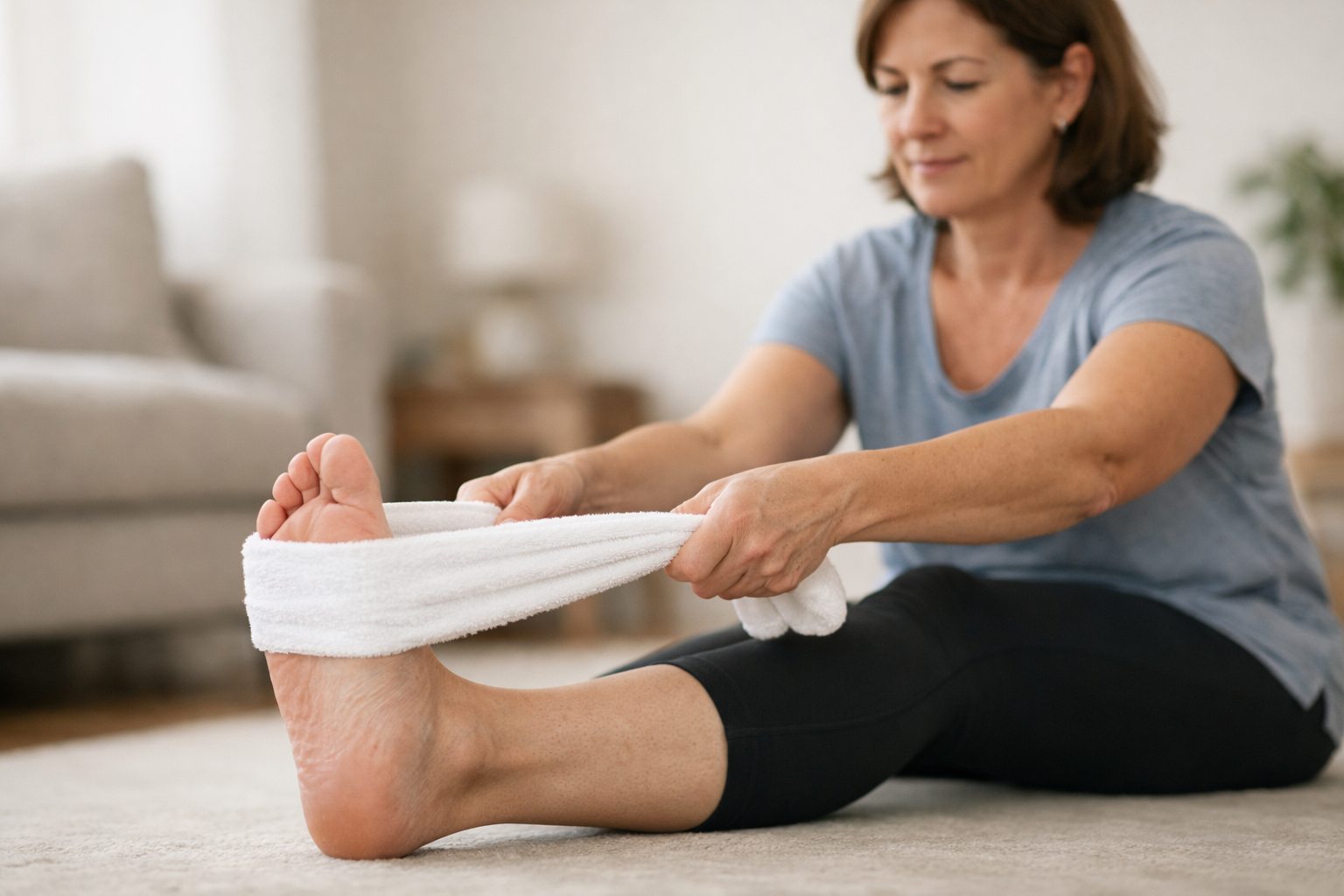
Sit with your leg out straight, loop a towel around the ball of your foot, and pull gently until you feel the calf lengthen. This is the friendliest option when you’re stiff and sore, because you control the force with your hands and can stop the instant it stings. It’s a reasonable morning option before you stand up.
6. Then load it
This is the part that changes the story over weeks rather than minutes. Stretching manages sensitivity. Building strength through range is what raises what the tendon can actually handle. Slow, controlled calf raises, both legs then eventually one leg, progressed gradually over months, are what most people are missing. We have a full progression written out in our guide to exercises for Achilles tendinitis, so I won’t duplicate it here. But if you take one thing from this article: stretching without loading is why the tightness keeps coming back.
When stretching makes things worse
There’s a specific situation where aggressive stretching reliably backfires, and it’s common enough that it’s worth knowing.
The Achilles attaches to the back of the heel bone. If your pain is right at that attachment point, low down on the heel rather than in the cord above it, that tissue gets compressed against the bone every time your ankle bends deeply. Stretching drives it into more of exactly that. People with pain at the attachment often describe stretching as feeling productive in the moment and awful the next morning.
Signs you may want to back off deep stretching for now:
- Pain is at the very back and bottom of the heel, not in the tendon itself
- The heel is tender to touch against a shoe counter or the back of a boot
- Deep dorsiflexion (heel-drop stretches, squatting deep, walking uphill) clearly provokes it
- Symptoms are worse the morning after you stretch hard
In that case, stay out of the bottom of the range. Work the calf with heel raises done on flat ground rather than off a step. Some people actually do better with a small heel lift in their shoe for a few weeks, which reduces how far the tendon gets pulled around the heel bone during every step.
The other time to ease off: when the tendon is in a hot, reactive phase. Sudden increase in pain, sore with almost anything, painful at rest. Stretching a tendon in that state usually adds to the pile. Calm it first with gentle isometric holds and reduced (not eliminated) activity, then reintroduce range work.
Should I massage my Achilles tendon if it hurts?
Gentle massage or soft tissue work on the calf muscle is fine and often feels good. Digging directly into a painful tendon is a different matter.
A couple of guidelines I give people:
- Work the calf belly, not the tendon itself. That’s where most of the protective tension lives anyway.
- Avoid grinding a foam roller or a lacrosse ball directly over the sore part of the tendon, particularly at the heel attachment. It’s compressing the exact tissue that’s already irritated.
- If it feels pleasant and you’re calmer afterward, it’s probably doing no harm. If you’re bracing and gritting your teeth, that’s not therapeutic, it’s just unpleasant.
Massage can reduce how sensitive things feel. It doesn’t build anything. Think of it as a comfort measure that makes the loading work more tolerable, not as treatment in its own right.
Is walking good for a tight Achilles?
Generally, yes. Walking is one of the better things you can do, with two adjustments.
First, flat ground beats hills. Uphill walking demands the most ankle bend and the most load through the tendon, and it’s one of the most common ways people accidentally flare themselves up on vacation or a hiking weekend.
Second, watch total volume rather than any single walk. Tendons respond to accumulation. Ten thousand steps at an airport, then a standing dinner, then a walk the next morning will find a tendon’s limit faster than one hard workout. And the response often shows up a day later, which is why people misidentify what caused the flare.
Complete rest is the option that looks safest and tends to work worst. A tendon that isn’t loaded gets weaker, and when you go back to normal life the same pain shows up at a lower threshold than before. Rest equals rust. Short periods of relative rest to calm things down, fine. Weeks of avoiding walking, not fine.
Use a simple rule: pain during and after activity that stays around a 4 out of 10 or below, and settles back to your baseline within about 24 hours, is generally acceptable. Pain that spikes higher than that, or is still elevated the following day, means the dose was too much. That’s information, not injury.
What not to do with a sore Achilles
A short list of the things that most reliably set people back:
- Sudden spikes. Jumping your running mileage, adding hill repeats, starting a new sport, or taking a job that puts you on your feet all day without a ramp-up.
- Ballistic stretching. Bouncing at the end of range on a step. All the provocation, none of the benefit.
- Stretching harder because it isn’t working. If four weeks of stretching hasn’t changed things, the answer is rarely more stretching.
- Sprinting or plyometrics in the reactive phase. Fast, springy loads are the highest demand a tendon sees. They’re a goal, not a starting point.
- Complete shutdown. Covered above, but it’s the most common mistake and worth repeating.
- Stopping the day the pain stops. This one costs people months. Pain often resolves well before the tendon has actually adapted. If you quit then, you’ve fixed the sensitivity and left the capacity where it was.
What are the worst shoes for a sore Achilles?
Shoes matter here more than they do for most foot problems, because heel height directly changes how much the tendon is stretched with every step.
The ones that cause the most trouble:
- Completely flat shoes. Minimalist trainers, flat fashion sneakers, flip flops, ballet flats. Zero heel drop means maximum ankle bend and maximum load on the tendon all day long. Some people do great in them long term. During a flare, they’re a hard ask.
- Anything with a stiff, high, rigid heel counter that presses into the back of your heel. Common in dress shoes, some hiking boots, and certain cleats. If your pain is at the attachment, this is mechanical irritation on top of everything else.
- Worn-out running shoes where the midsole has flattened out and stopped absorbing anything.
- Barefoot on hard floors all day at home, which is the hidden one. People fix their shoes and then spend eleven hours on tile.
What tends to feel better during a sore phase: a shoe with a modest heel-to-toe drop, a reasonably cushioned midsole, and a soft or lower heel collar. A small heel lift inserted into your existing shoes is a legitimate short-term tool for reducing tendon strain while you build strength. It’s a temporary support, not a permanent solution.
And a note for people who switched to zero-drop shoes and then developed heel pain: the shoes didn’t damage you. The change in demand happened faster than your tendon could adapt to it. That’s a transition problem, and it’s usually solvable by going back for a while and returning more gradually.
What gets mistaken for Achilles tendonitis?
Not everything at the back of the ankle is the tendon. The ones I see confused most often:
- Retrocalcaneal bursitis. A small fluid-filled sac between the tendon and the heel bone gets irritated. Swelling and tenderness sit slightly deeper and more to the sides of the tendon than on it. Shoe pressure is often the main aggravator.
- Insertional versus midportion tendon problems. Both are the Achilles, but they behave differently. Midportion (two to six centimeters above the heel) generally tolerates stretching and heel drops. Insertional (right at the bone) generally doesn’t. Treating one like the other is a common reason progress stalls.
- Posterior ankle impingement. Deep pain at the back of the ankle when you point your toes down, common in dancers and soccer players. Feels quite different from tendon pain, which hates being stretched rather than pointed.
- Sural nerve irritation. Burning, tingling, or an electric quality along the outside of the Achilles and into the outer foot. Nerve symptoms don’t respond to tendon loading the way tendon pain does.
- A partial tear or a stress reaction in the heel bone. Less common, but a reason not to push through pain that’s sharp, sudden, or clearly worsening week over week.
- Referred pain from the low back or calf. Occasionally the tendon is innocent.
An in-person exam sorts most of this out quickly. A few specific tests, pressing in a few specific places, and watching you move usually tells us more than imaging does.
How long does a sore Achilles take to settle?
The honest answer is that it depends on how long it’s been going on and how much you’re asking of it, but some general patterns hold.
Early, mild irritation caught within a few weeks often calms down noticeably within a few weeks of sensible loading and activity adjustment.
A tendon that’s been grumbling for six months or a year is a different project. Tissue adaptation generally takes somewhere in the range of eight to twelve weeks of consistent, progressive loading before the structure itself starts changing, and full return to running or sport often takes longer than that. The first few weeks of improvement are mostly your nervous system getting more comfortable and your muscles firing better. That’s real progress, and it’s also why people feel great at week four and stop, then find themselves back at square one in the spring.
Persistent doesn’t mean permanent. A tendon that’s been sore for two years isn’t beyond help, it just means starting lower and being more patient with the climb.
One more thing about how to measure progress. Pain is one signal, and not the most useful one week to week. Ask better questions: Am I stiff for five minutes in the morning instead of thirty? Can I walk further before it shows up? Does it settle faster after activity than it did a month ago? Can I do more heel raises than I could three weeks ago? Those often improve before the pain number does, and they tell you the tendon is genuinely getting more capable.
A flare-up along the way doesn’t erase any of it. Look at what changed (a longer day, new shoes, a hill, less sleep), adjust the dose, and keep going. The line up is bumpy for almost everyone.
A practical starting point
If you’re not sure where to begin and your pain is in the cord above the heel rather than at the bone:
- Ankle rockers and easy range of motion, morning and before activity.
- Soleus stretch (knee bent) and gastroc stretch (knee straight), 30 to 45 seconds each, two rounds per side, most days.
- Slow, controlled calf raises on flat ground, both legs, with a pause at the top. Build these steadily over weeks before adding step drops or single-leg work.
- Keep walking, keep the total day’s load reasonably steady rather than swinging between nothing and everything.
- Check the response the next morning. Back to baseline within about a day means the dose was right.
If your pain sits at the heel attachment, drop the deep stretching for now, keep heel raises on flat ground, and consider a temporary heel lift.
When to get it looked at
See a clinician if the pain isn’t trending better after several weeks of sensible work, if it’s getting worse rather than better, if there’s significant swelling or a palpable lump or gap in the tendon, if you had a sudden sharp pain or a snapping sensation and struggle to push off, or if you can’t do a single-leg heel raise on that side. Sudden, severe symptoms deserve a prompt evaluation rather than a wait-and-see approach.
The rest of it, the stiff mornings and the ache after long days, usually responds well once the loading is right. Stretching has a place in that. It’s just rarely the whole plan.