Do Ankle Braces Really Help? What the Evidence Shows
Ankle braces do less than most people hope and more than skeptics admit. Here is what a brace actually does, when it earns its place, and why it works best alongside rebuilding what your ankle can handle.
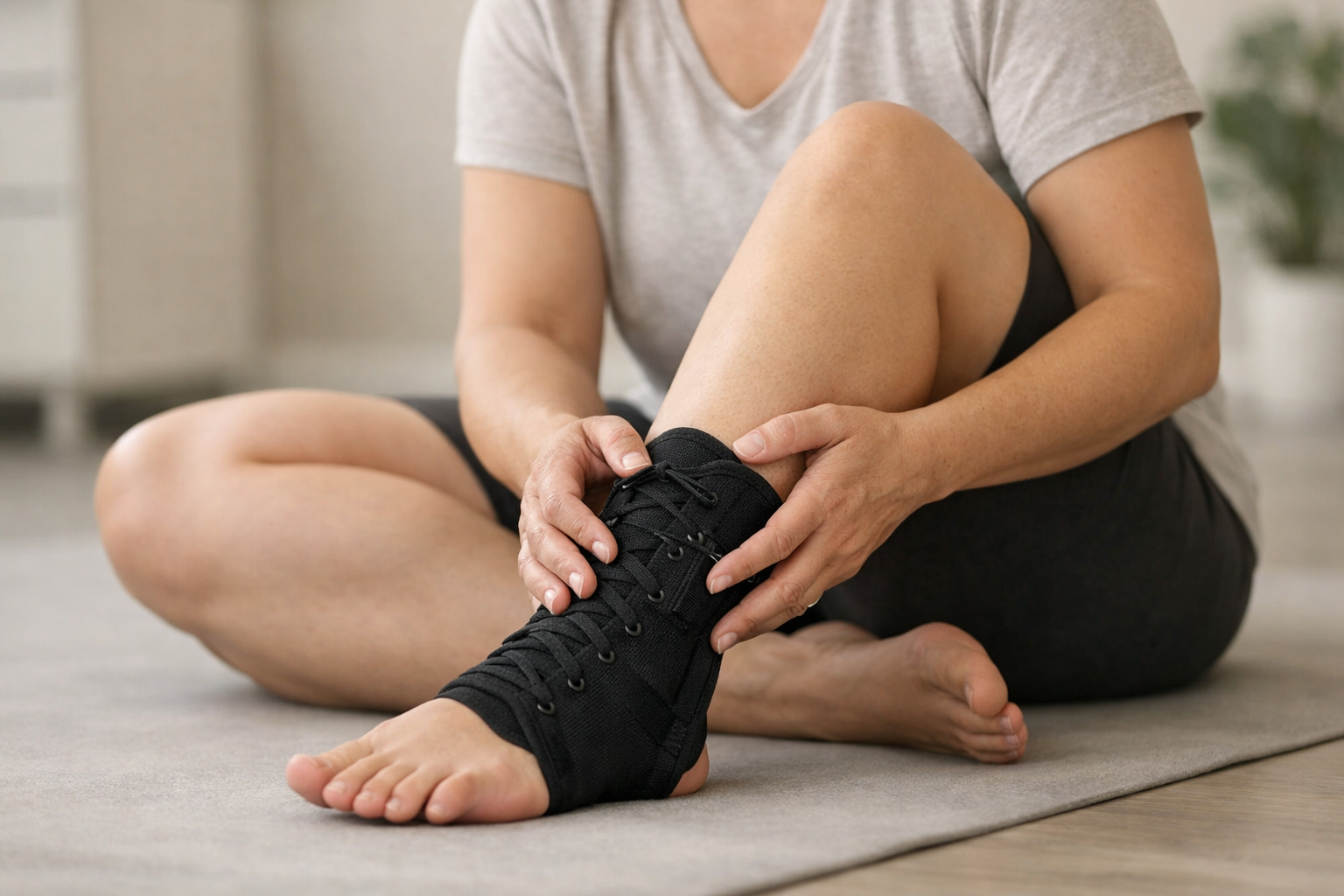
Most people ask me about ankle braces for one of two reasons. Either they just rolled an ankle and want to know if a brace will help it heal, or they’ve rolled the same ankle four or five times and they’re wondering if they should just wear a brace forever.
Those are different questions with different answers. And neither answer is “a brace will take care of it.”
Here’s the short version, and then I’ll explain the reasoning. A brace is genuinely useful. It reduces the chance of rolling an ankle again, especially if you’ve rolled it before. It helps you stay active while healing tissue catches up. What it does not do is make your ankle stronger, more coordinated, or more capable. Those things get built. A brace buys you time and margin while you build them.
What does wearing an ankle brace actually do?
Three things, mostly.
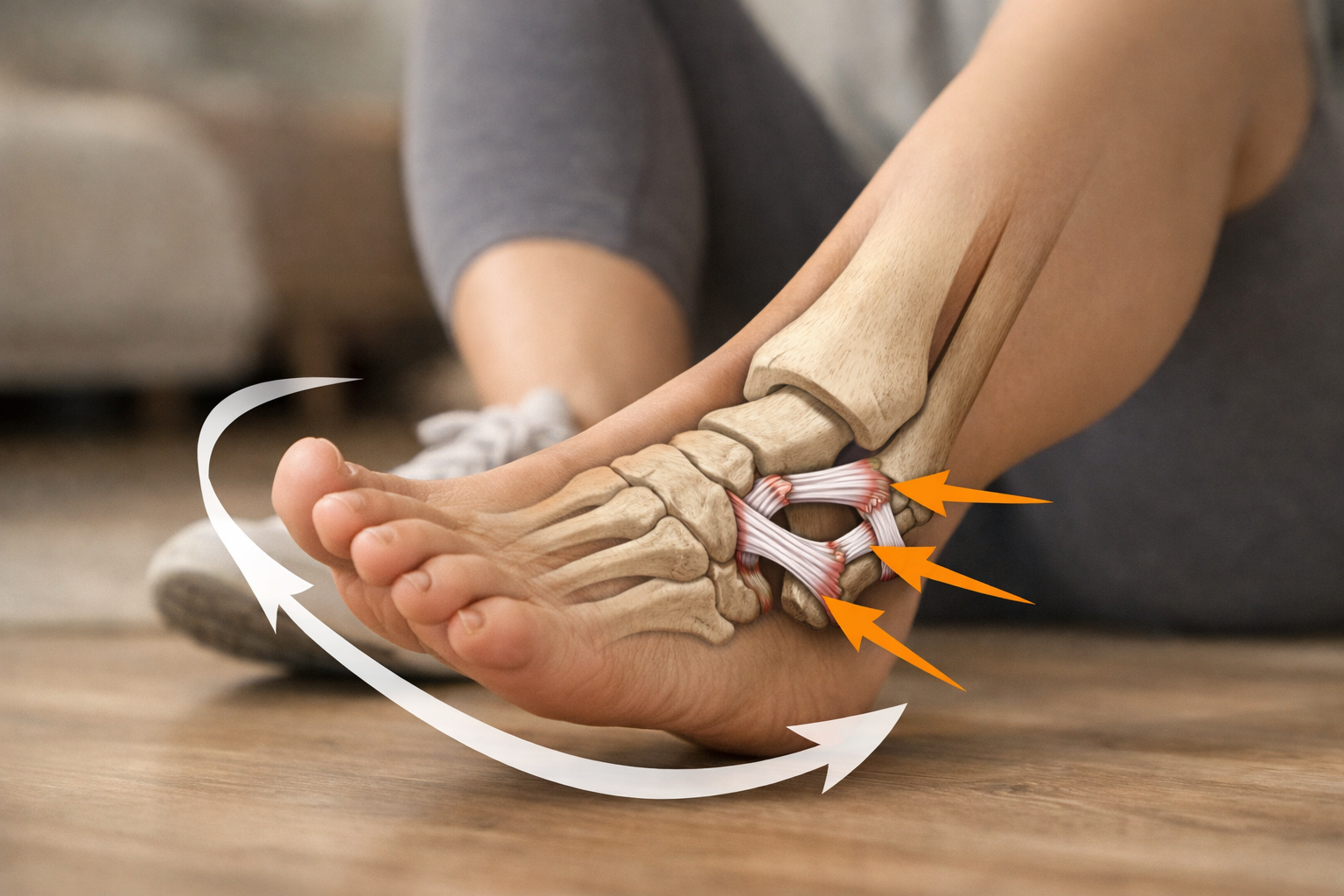
It limits how far your ankle can roll. Most ankle sprains happen when the foot turns inward under you (the technical word is inversion) and the ligaments on the outside of the ankle get stretched past what they can tolerate. A brace with real structure to it, either stirrup-style plastic or laces with straps, physically stops the ankle before it reaches that end range. Less range, less chance of the ligament getting overloaded.
It gives your nervous system information. This part gets underrated. After you sprain an ankle, your sense of where that joint is in space gets a little foggy. The pressure and tension of a brace against your skin feeds your brain constant feedback about ankle position. Some of the protective effect of bracing is probably less about the mechanical block and more about your body reacting a half-beat sooner when the ankle starts to go.
It changes how confidently you move. If you trust your ankle, you walk normally, you push off, you stop hesitating on uneven ground. Confidence is not a side note in recovery. People who move normally get better faster than people who limp around protecting a joint for weeks.
What a brace does not do: heal the ligament, restore your balance, rebuild the strength of the muscles that control your foot and ankle, or address why the ankle keeps giving out. It’s a tool for managing load, not a treatment.
The load and capacity part, because it explains everything else
An ankle sprain, at its simplest, is a moment where the demand on a ligament exceeded what that ligament could handle. Bad step off a curb. Foot landing on the edge of someone else’s shoe. Trail run in the dark.
Recovery works the same way in reverse. The ankle has to become capable of handling the things you want it to do, including the awkward, unplanned things. Standing on one leg while you reach for something. Cutting to your left on grass. Carrying a laundry basket down stairs.
A brace lowers the demand side of that equation. It’s a way of keeping the load under your current ceiling. That’s valuable, particularly early on and particularly if you’re trying to get back to sport before your ankle is fully ready. But lowering demand forever is not the same as raising capacity. If the brace is the only thing standing between you and another sprain three years from now, nothing actually changed.
This is the gap I see most often. Someone gets a brace, the ankle stops hurting, they go back to normal life, and nobody ever built the calf strength, the single-leg balance, or the tolerance for quick direction changes that would have made the brace optional. Then it happens again. The brace wasn’t wrong. It just wasn’t the whole plan.
Ankle brace versus ankle support: is there a difference?
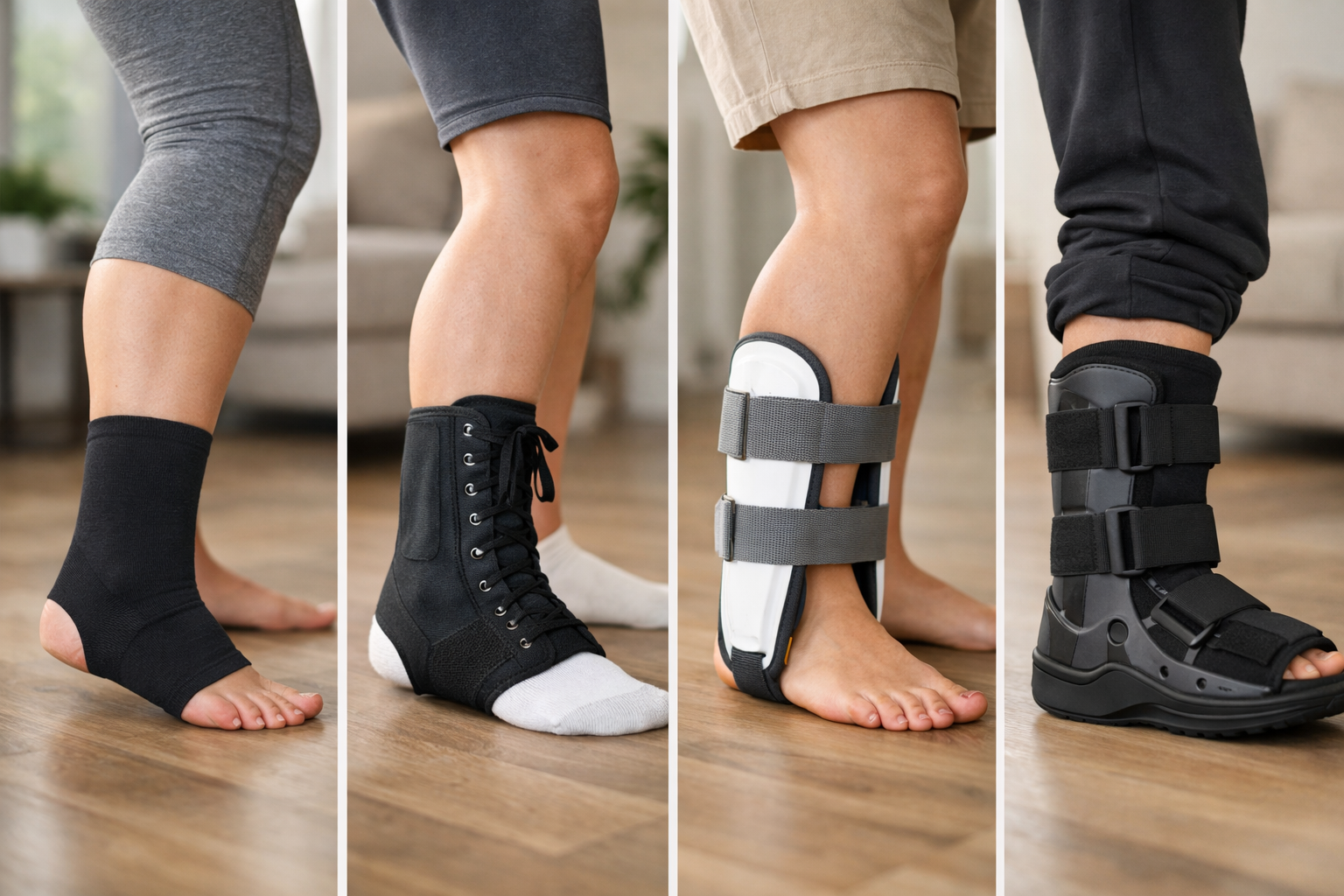
People use the words interchangeably, and manufacturers don’t help. Practically speaking, there’s a spectrum, and where a product sits on that spectrum matters a lot more than what it’s called.
Compression sleeves. Elastic, pull-on, no rigid parts. These provide compression and skin feedback. They feel good. They can help with swelling and they give you that sense of the joint being “held.” They do very little to stop your ankle from rolling. Fine for mild aches and post-activity comfort. Not the thing you want if your ankle actively gives out.
Lace-up braces. Fabric with laces, usually with figure-eight straps that wrap around like tape. Moderate to good restriction of side-to-side motion while still letting you point and flex your foot. Fits reasonably well in a shoe. This is the workhorse for most people returning to sport or dealing with an ankle that feels unreliable.
Semi-rigid stirrup braces. Two plastic shells with air or gel bladders, connected under the heel, strapped over the top. These are the most effective at blocking inversion. They’re bulkier. They limit motion the most, which is exactly what you want early after a real sprain, and less of what you want later when you’re trying to move athletically.
Walking boots and rigid immobilizers. A different category entirely. These are for significant injuries and fractures, usually short-term, usually prescribed. Not something to reach for on your own.
So when someone says “support” they often mean a sleeve, and when they say “brace” they often mean something with structure. If you’re buying for actual instability, look at what the thing physically does, not the marketing tier it’s assigned.
What type of ankle brace is best?
The honest answer is that it depends on the problem you’re solving, and there’s no single best model.
Recent sprain, still swollen and tender: something with real structure, often a stirrup-style brace, for a couple of weeks. You want to protect the ligament while it starts to heal, without shutting the whole leg down.
Returning to court or field sport after a sprain: lace-up with straps is usually the sweet spot. Enough restriction to matter, enough freedom to move athletically, and it fits in an athletic shoe.
An ankle that has rolled repeatedly over the years: lace-up brace for the activities where it matters most, paired with actual strength and balance work. This is where bracing has the strongest track record. Reducing repeat sprains is what braces do best.
Vague soreness, mild swelling, long day on your feet: a sleeve is reasonable. It’s a comfort tool. Treat it as one.
Hiking or travel with an ankle you don’t quite trust: something low-profile and structured, worn for the parts of the trip that actually challenge the ankle, not for eighteen hours straight.
One more thing on fit, because a poorly fitted brace is close to useless. It should be snug enough that it doesn’t shift inside your shoe when you move. If you can slide your ankle around inside the brace, the brace isn’t restricting anything. Straps should be tight enough to feel firm but not tight enough to make your toes tingle or go numb. If you tighten it in the morning and it’s loose by lunch, you either need to retighten it or you need a different size.
Should the brace go over or under your sock?
Over the sock, almost always.
A thin sock between your skin and the brace cuts down on rubbing, blisters, and the general misery of hard plastic and nylon against damp skin. Then the brace goes on top. Some lace-up designs come with a sleeve layer built in, which handles this for you.
If you’re going to be in a brace for hours, that layer of sock is the difference between a tolerable day and raw skin on your heel by 3 p.m. Bring a spare pair if your feet sweat.
Can you wear shoes with an ankle brace?
Yes, and you should. A brace worn without a shoe leaves your foot and ankle less supported than either one alone would suggest, and the brace itself tends to slide.
A few practical notes:
- Lace-up braces and slim stirrups fit most athletic shoes. You may need to loosen the shoe’s laces a hole or two.
- If you’re regularly bracing one ankle, you might find you need a slightly wider or half-size-larger shoe. Some people keep a dedicated pair.
- Skip low-profile, tight-fitting shoes when braced. Cramming a brace into a shoe that has no room turns it into a pressure point.
- Boots with high ankle collars can conflict with a brace. Try the combination before you take it on a hike.
- Avoid wearing a structured brace with a shoe that has a lot of heel-to-toe drop and a soft, unstable sole. You want the whole system to feel like one unit.
Should you wear an ankle brace while walking?
Usually yes, early on, and here’s the reasoning: the goal after a sprain is to walk normally as soon as you reasonably can. Not to avoid walking.
When you limp, everything upstream compensates. Your calf stops working the way it should. Your hip takes over. The ankle stiffens. Weeks of that leaves you with a joint that’s technically healed and functionally lousy. If a brace lets you walk with a normal heel-to-toe pattern instead of hobbling, the brace is doing exactly what it should.
So in the first stretch after a sprain, wearing it for walking makes sense. As things settle, start letting the ankle work on its own for the easy stuff. Around the house. Short errands on flat ground. Save the brace for the harder demands: long days, uneven terrain, anything with cutting or jumping.
What you want to avoid is the ankle never being asked to do its own job. Rest and protection calm things down, but the ankle eventually has to become capable of the world it lives in. Rest equals rust if you stay there too long.
How many hours a day can you wear an ankle brace?
There’s no hard limit, and for most people this is more about strategy than a number on a clock.
In the first week or two after a meaningful sprain, wearing a brace during all your weight-bearing hours is reasonable. Take it off to sleep, take it off to shower, take it off periodically to move the ankle gently through its range and let your skin breathe.
After that, I’d rather you think in terms of activities than hours. Brace for the things that genuinely challenge the ankle. Go without for the things that don’t. That way the ankle keeps getting asked to do progressively more on its own, which is how capacity gets built, while you still have protection where the risk is real.
The long-term case is different. Plenty of athletes brace for competition indefinitely, and there’s nothing wrong with that. Tennis players, basketball players, people who work on scaffolding. The brace is equipment. What I’d push back on is wearing a brace all day, every day, for years, while never doing anything to improve what the ankle itself can handle. That’s not protection at that point. That’s substitution.
And no, wearing a brace does not automatically weaken your ankle. The idea gets repeated a lot and it’s overstated. What weakens an ankle is not using it. If the brace lets you be more active, you’re probably ahead. If the brace lets you avoid ever challenging the joint, that’s where the trouble is, and the brace is a bystander to a choice you made.
When should you wear an ankle brace?
The situations where bracing tends to earn its place:
- The first few weeks after a sprain, to keep you walking normally and protect healing tissue.
- Returning to sport after a sprain, particularly in the first few months, when the risk of doing it again is highest.
- An ankle with a history of repeated sprains. This is the strongest case. Reducing repeat sprains in people who have already sprained an ankle is the clearest, most consistent thing braces do.
- Specific high-risk activities. Basketball, volleyball, soccer, trail running, ladder work, uneven ground.
- Long travel days or unfamiliar terrain, if you don’t yet trust the ankle.
And where I’d think twice:
- Heel or arch pain that isn’t actually an ankle stability problem. A brace won’t do much for plantar fascia pain or an irritated Achilles. Those are load-tolerance problems in a different tissue, and they respond to a different approach.
- Swelling with no clear cause. Get it looked at first.
- As a permanent replacement for strength and balance work in a healthy, motivated person who wants their ankle to be genuinely reliable.
What actually reduces the odds of the next sprain
Bracing helps. So does the boring stuff that nobody photographs for a product page.
Calf and foot strength. Heel raises, done with enough weight and enough repetitions to matter, including on one leg. Your calf is the primary brake on your ankle. A strong one absorbs force that would otherwise hit ligaments.
Balance and single-leg control. Standing on one foot progresses further than people expect: eyes closed, on a cushion, while reaching in different directions, while catching something. This retrains the position sense that gets blunted by a sprain.
Hopping and landing. Eventually you need the ankle to handle force arriving fast. Small hops, then hops with direction changes, then whatever your sport demands. Sprains happen in fractions of a second, so at some point training has to happen at that speed too.
Gradual exposure to the real thing. If you play soccer, you need to cut on grass again. If you hike, you need to walk on rocks again. Start below what you think you can handle, watch how the ankle responds over the next day, and build from there. Your response tells us what comes next better than any calendar does.
This takes weeks to months, not days. Early improvements come quickly, mostly because your nervous system gets better at coordinating what you already have. The tissue itself adapts more slowly. That mismatch is exactly why people stop when their ankle stops hurting, feel fine for a while, and then roll it again.
What are four signs an ankle sprain is bad?
Most sprains do well with sensible loading and time. Some need imaging or a hands-on evaluation first. Things that should push you toward getting it looked at:
- You can’t put meaningful weight on it. If four steps is genuinely not possible, or if bearing weight produces sharp pain rather than soreness, that raises the question of a fracture.
- Bone that hurts to touch. Pinpoint tenderness right on the bony knobs of the ankle, or along the outer edge of the foot, is different from diffuse soreness over soft tissue.
- Swelling and bruising that come on fast and hard. Significant swelling within the first hour, or bruising that spreads across the foot, suggests more tissue involvement.
- A feeling of giving way, or pain above the ankle. If the joint feels loose or shifts under you, or if pain sits higher up between the shin bones rather than at the ankle itself, that pattern deserves a proper look. So does an ankle that isn’t improving at all after a couple of weeks.
Also worth knowing: not every pain around the ankle and heel is a sprain. Tendon problems, nerve irritation, stress reactions in bone, and plantar fascia issues can all show up in the same neighborhood and can be consistent with several different things. An evaluation sorts out which one you’re dealing with, and that matters, because the plan is different for each.
The way I’d frame the decision
If you’ve sprained your ankle recently, or more than once, a brace is a reasonable, evidence-supported piece of equipment. Buy something with actual structure, not just compression, fit it snugly over a sock, wear it inside a shoe with enough room, and use it for the demands that warrant it.
Then treat it as the beginning of the plan rather than the plan. The brace manages what your ankle has to handle right now. Everything else is about raising what your ankle can handle, so that a year from now the brace is a choice instead of a requirement.
If your ankle isn’t improving, keeps giving out, or you’re not sure what you’re dealing with, get it evaluated in person. Pain that’s severe, worsening, or dragging on well past what seems reasonable is worth a set of eyes and hands on it rather than a guess.